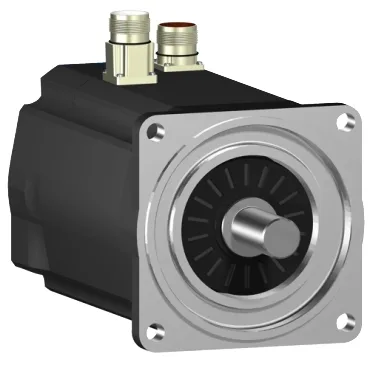
Torque and power delivery across the voltage range
The SH31004P02A1100 delivers 10 Nm continuous stall torque (88.5 lbf.in) across the full 115...480 V three-phase range, with peak stall torque reaching 40.5 Nm (358.5 lbf.in) for short-duration moves. Nominal output power climbs from 780 W at 115 V single phase to 2600 W at 480 V three phase, so the usable power depends on the supply voltage you feed it — at 400 V three phase you get 2480 W, close to the 2500 W continuous power rating. Torque constant is 1.62 N.m/A at 120 °C copper temperature, and the back EMF constant is 103 V/krpm at 20 °C. These numbers let you size the drive current loop and predict the bus voltage headroom at speed.
Speed range and encoder feedback for position loops
Nominal speed varies with supply: 750 rpm at 115 V single phase, 1500 rpm at 230 V single phase, 3000 rpm at 400 V three phase, and 3600 rpm at 480 V three phase. Maximum mechanical speed is 6000 rpm, so the motor can overspeed in the field-weakening region if the drive supports it. The absolute multiturn SinCos Hiperface encoder gives position feedback without a home cycle after power loss — critical for gantry or rotary indexing applications where re-referencing costs cycle time. The 4-pole motor pairs naturally with drives that expect a 4-pole resolver or encoder feedback.
Mounting, cooling, and environmental sealing
Flange size is 100 mm (3.9 in) with a 95 mm centring collar and 9.0 mm mounting holes — standard IEC metric pattern. The smooth shaft is 24 mm diameter by 50 mm long, so couplings or pulleys must be clamped, not keyed. Cooling is natural convection, so no forced-air clearance or ducting is needed, but the ambient temperature must stay within the 130 °C copper hot-spot limit.
Electrical interface and current draw for drive sizing
Continuous stall current is 6.2 A, while the maximum RMS current is 32.3 A — the drive must supply the peak current for acceleration without tripping its own current limit. Stator resistance is 1.81 Ohm and inductance is 18.35 mH, which sets the electrical time constant and influences the drive's current regulator tuning. The rotatable right-angled connector and straight connector give flexibility for cable exit direction in tight cabinets — the installer can orient the connector before final torque.