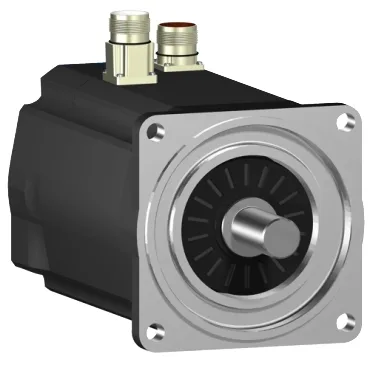
Motor frame and feedback — what the flange size and encoder tell you
The SH31004P02A1200: This SH3-series servo carries a 100 mm flange (IEC standard) and a smooth shaft — no keyway, so the coupling or pulley clamps directly to the 24 mm shaft diameter. The shaft extension is 50 mm, giving enough engagement for a bell-housing or timing pulley without a spacer. Feedback is an absolute multiturn SinCos Hiperface encoder — single-cable feedback that reports position on power-up without a home cycle. The multiturn count tracks revolutions even when the drive is off, which matters for pick-and-place or gantry axes that need absolute position after a power cycle.
Torque and speed across supply voltages — the real operating envelope
Nominal torque drops as supply voltage rises: 9.9 Nm at 115 V single-phase, 9.5 Nm at 230 V single-phase, 7.9 Nm at 400 V three-phase, and 6.9 Nm at 480 V three-phase. The continuous stall torque is a flat 10 Nm across the 115–480 V three-phase range, so the motor holds position torque regardless of line voltage. Nominal speed also follows the supply: 750 rpm at 115 V single-phase, 1500 rpm at 230 V single-phase, 3000 rpm at 400 V three-phase, and 3600 rpm at 480 V three-phase. The mechanical ceiling is 6000 rpm, but the winding voltage limits the top speed at lower line voltages — you won't reach 6000 rpm on a 115 V feed. Peak stall torque is 40.5 Nm across the three-phase range — that's roughly 4× the continuous stall rating, giving the headroom for acceleration and deceleration in indexing applications. The 3-second peak current is 32.3 A, so the drive must be sized to deliver that burst without tripping.
IP rating and cooling — where this motor lives
IP65 on the motor body and shaft bushing, IP67 on the housing — the motor handles washdown and dust ingress, but the shaft seal is the wet-end barrier. The straight connector exits the motor body, so the cable entry point is also sealed when mated. Cooling is natural convection — no fan or blower. Continuous power is 2.5 kW, but that assumes free airflow around the finned housing. If the motor is shoehorned into a tight enclosure or mounted with the flange against a heat sink, the continuous torque may need derating.