Speed, torque and power across supply voltages
The SH31004P12F1000 delivers its full rated continuous power of 2500 W at 400 V three-phase supply, where nominal speed is 3000 rpm and nominal torque is 7.9 N·m. At 480 V three phase, nominal speed rises to 3600 rpm with torque dropping to 6.9 N·m and output power increasing slightly to 2600 W. On single-phase supplies the motor derates significantly: 780 W at 115 V, 1490 W at 230 V — the three-phase connection is the intended operating mode. Peak stall torque reaches 40.5 N·m across the 115–480 V three-phase range, giving a 4:1 overload margin over the 10 N·m continuous stall torque. This handles acceleration through high-inertia loads or momentary overloads during cycle start.
Holding brake and encoder — what they mean for integration
The integrated holding brake provides 12 N·m of holding torque — enough to hold the rated continuous load at standstill without back-driving. The brake is spring-applied, power-released; it engages when drive power is removed, preventing axis drift on a vertical or inclined axis. The absolute multiturn SinCos Hiperface encoder retains position through power cycles — no homing sequence is needed on restart. This saves cycle time in applications where the machine must resume from the last known position after a power interruption or emergency stop.
Mounting dimensions and environmental sealing
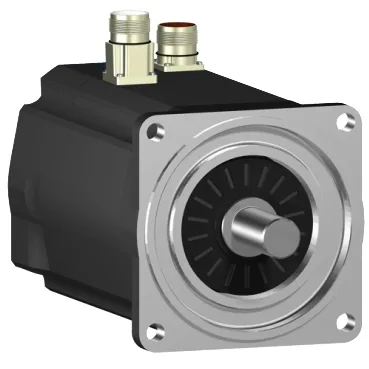
The motor uses a 100 mm international standard flange (motor flange size 3.9 in / 100 mm), with four mounting holes on a 9.0 mm diameter bolt circle. Shaft diameter is 24 mm with a parallel key and 50 mm shaft length — a common NEMA/metric hybrid size that mates with standard couplings and pulleys. IP degree of protection is IP54 at the shaft bushing without the shaft seal ring, and IP65 on the motor body and with the shaft bushing seal ring fitted. In a washdown environment — food processing, chemical dosing — the IP65 configuration is required; the seal ring must be specified at order. Natural convection cooling means no external fan; the motor relies on heat dissipation through the flange and housing.
Electrical parameters for drive tuning
Stator resistance is 1.81 Ω and stator inductance is 18.35 mH — these go into the drive's auto-tuning routine for current loop gains. The torque constant is 1.62 N·m/A at 120 °C copper temperature; the back EMF constant is 103 V/krpm at 20 °C. Maximum RMS current is 32.3 A, which matches the 3-second peak current rating — the drive's peak current limit should be set to this value.