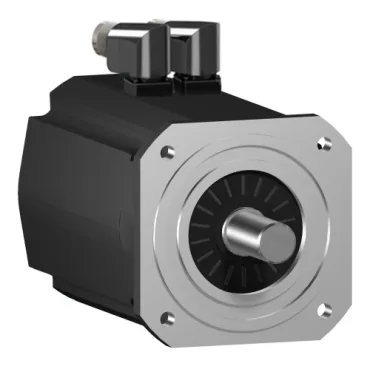
Servo motor definition and what SH32051P01A2200 actually is
Nominal torque follows the same voltage curve and sits between 13.8 N·m at 480 V and 31.9 N·m at 115 V single-phase — the higher low-speed torque at reduced voltage is the constant-torque region of the drive's current loop, useful where the mechanical load is torque-limited at start-up.
Speed envelope and torque constant
Torque constant Kt is 1.6 N·m/A at the 120 °C copper hot point and back-EMF Ke is 104 V/krpm at 20 °C, which together define the current required for a given torque command and the line-to-line voltage needed to hold speed at the field-weakening threshold. Peak stall torque reaches 110 N·m at 115–480 V three-phase, more than three times nominal — the drive's current-foldback profile must be configured to allow those short-duration transients without tripping on I²t, since the continuous stall current is 21 A but maximum Irms is 87.2 A.
Mechanical fit and shaft loading
The motor is built on an 205 mm flange with a 180 mm centring collar 4 mm deep, four 14 mm mounting holes on the standard pattern, and an overall length of 321 mm with a 80 mm shaft stick-out — the cabinet cut-out and machine sub-plate have to be laid out against these dimensions before the cable glands are punched. Shaft load ratings are 740 N maximum axial force and 3730 N radial at 1000 rpm, stepping down to 2960 N at 2000 rpm and 2580 N at 3000 rpm — the higher speed the gearbox or coupling runs at, the less radial load the shaft tolerates, which is the typical constraint when a belt drive or pinion is mounted direct. No holding brake is fitted (option coded out), so a back-up brake on the gearbox or an external shaft brake is required for any vertical-axis application where the load must hold position with the drive powered down.
Sealing, cooling and connection
Sealing is rated IP65 on the motor body, IP65 on the shaft bushing and IP67 on the housing to IEC 60034-5, which is sufficient for washdown-adjacent food-and-bev lines and outdoor skids — the lower shaft-bushing rating is the usual entry point for water-ingress during high-pressure cleaning, so a shaft-seal retrofit is worth considering if the cabinet sees daily hose-down. Cooling is natural convection with no integrated fan, so the motor must be mounted with the airflow path clear and derated if it is enclosed in a sealed cabinet — the 5.5 kW continuous figure assumes free air around the body, not a blanketed back-of-panel mount. The power and feedback signals leave through a rotatable right-angled connector, which lets the cable exit be set to the cabinet side after mounting rather than before — a small thing, but it keeps the cable bend radius in spec when the cabinet layout tightens up.