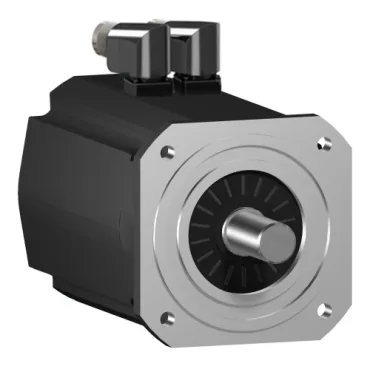
What the SH32051P02F2000 actually is
It is built as a 5-pole, natural-convection servo in a 14.6 in (370.5 mm) long package, terminating in a straight or rotatable right-angled connector so the same motor drops into cabinets with different cable-routing constraints (cites:,).
Torque and power envelope — what the BOM line is sized against
Holding torque is 708.06 lbf.in (80 N.m), continuous stall torque is 326.6 lbf.in (36.9 N.m) across the 115 to 480 V range, and peak stall torque reaches 973.6 lbf.in (110 N.m) — so a sizing exercise lives inside the 36.9 N.m continuous number with 110 N.m available for short accelerations (cites:,). Continuous power is 5.5 kW, but the nominal output power shifts with the bus: 2510 W at 115 V single phase, 4240 W at 230 V single phase, 5500 W at 400 V three phase, and 5200 W at 480 V three phase, which is the figure that decides which drive rating the SH32051P02F2000 pairs with (cites:,). Nominal torque tracks the same voltage curve — 31.9 N.m at 115 V single phase down to 13.8 N.m at 480 V three phase — and nominal speed climbs from 750 rpm at 115 V single phase to 3600 rpm at 480 V three phase, so the mechanical operating point on the machine is set jointly by the drive bus and the gearbox ratio (cites:,). Peak current is 87.2 A Irms (and the 3-second peak output current is the same figure), which is the number the drive sizing block must clear on the overload profile (cites:,).
Mechanical fit and forces on the shaft
Mounting is via the international standard flange with four 14 mm clearance holes on a 180 mm centring collar, and the shaft is 38 mm diameter by 80 mm long — a smooth shaft, so the coupling choice is a clamp-style or keyed compression hub rather than a keyed bore (cites:,). Maximum radial force is 3730 N at 1000 rpm, falling to 2580 N at 3000 rpm, and maximum axial force is 740 N — these are the loads the gearbox or pulley must respect before the bearing life curve derates the motor (cites:,).
Sealing, thermal, and what the cabinet has to give it
Cooling is natural convection with a 130 °C copper-hot temperature limit, which means the cabinet heat-load calculation must budget for the full 5.5 kW dissipation under stall — no fan is built in, so the enclosure's own airflow carries the thermal load (cites:,).