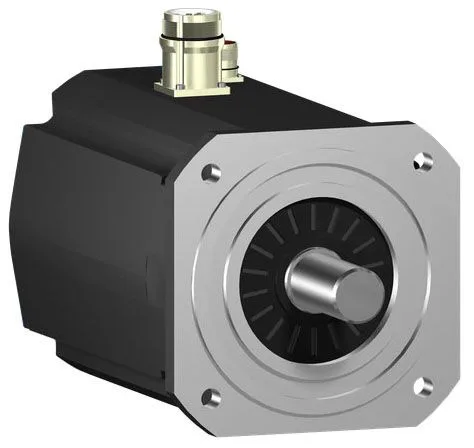
Motor dimensions and mounting — what fits the frame
The SH32051P11A1100: Overall length is 12.6 in (321 mm) with a shaft diameter of 1.5 in (38 mm) and a parallel key shaft end — the key width is 0.4 in (10 mm). The shaft length is 3.1 in (80 mm). Mounting uses an international standard flange with flange size 8.07 in (205 mm), centring collar diameter 7.09 in (180 mm), and centring collar depth 0.2 in (4 mm). Four mounting holes at 0.6 in (14 mm) diameter.
Torque and speed across supply voltages — the real operating envelope
This is a three-phase servo motor with 5 poles. Nominal speed depends on supply: 750 rpm at 115 V single-phase, 1500 rpm at 230 V single-phase, 3000 rpm at 400 V three-phase, and 3600 rpm at 480 V three-phase. Nominal torque also varies: 31.9 N·m at 115 V single-phase, 27 N·m at 230 V single-phase, 17.5 N·m at 400 V three-phase, and 13.8 N·m at 480 V three-phase. Continuous power at 400 V three-phase is 5500 W. Continuous stall torque is 36.9 N·m across the 115...480 V three-phase range. Peak stall torque reaches 110 N·m across the same voltage range — that's the short-term overload capability for acceleration or deceleration. Maximum current Irms is 87.2 A, and the output current 3s peak is also 87.2 A — the peak current limit matches the maximum continuous current, so the motor's thermal limit is the binding constraint during overloads.
Encoder, feedback, and electrical connection
The encoder is an absolute single-turn SinCos Hiperface type — this gives position feedback at power-up without a homing cycle, and the SinCos analog track provides velocity ripple below what incremental encoders deliver. Electrical connection options: a rotatable right-angled connector or a straight connector — choose based on cable exit direction in the cabinet. IP65 protection on both the motor body and the shaft bushing, conforming to IEC 60034-5. Stator resistance is 0.3 Ω and stator inductance is 2.97 mH — these set the electrical time constant and influence the servo drive's tuning gains. Torque constant is 1.75 N·m/A at 120 °C copper temperature; back EMF constant is 104 V/krpm at 20 °C.
Bearing loads and thermal limits
Maximum radial force Fr depends on speed: 3730 N at 1000 rpm, 2960 N at 2000 rpm, and 2580 N at 3000 rpm. Maximum axial force Fa is 740 N. These are the limits for belt-drive or direct-coupling applications — overshoot them and bearing life drops sharply. Hot-spot copper temperature is rated at 130 °C — the winding insulation class supports this continuous temperature. Natural convection cooling means the motor relies on its own surface area to dissipate heat; derate if mounted in a confined space or near heat sources.
Sourced through independent distribution channels. The sizing reference is SH32051P; the device short name is SH3.