Speed-torque map across supply voltages
The SH32051P12F2200: This SH3 series servo motor delivers 5500 W continuous power at 400 V three-phase, but the nominal torque drops from 31.9 N·m at 115 V single-phase to 13.8 N·m at 480 V three-phase — the voltage determines the torque ceiling, not the speed. At 400 V three-phase the motor spins 3000 rpm; at 480 V it reaches 3600 rpm, so the drive's DC bus voltage directly sets the speed range. Peak stall torque holds at 110 N·m across the 115...480 V three-phase range, but the 87.2 A peak current (3 s) must be within the servo drive's peak current rating — the torque constant of 1.75 N·m/A at 120 °C gives the current-loop gain target.
Holding brake and mechanical integration
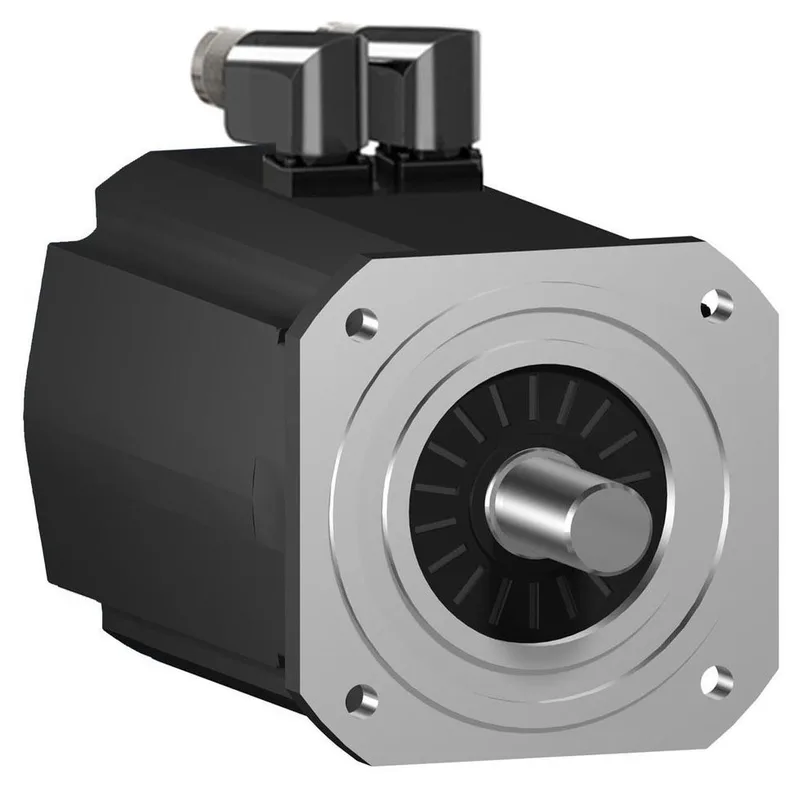
The 80 N·m holding brake locks the shaft when power is removed — critical for vertical-axis loads where the axis must not drift on power loss. The 38 mm shaft with parallel key and 10 mm key width matches standard coupling bores; the 205 mm flange with 14 mm mounting holes and 4 mm centring collar depth bolts to a standard international flange pattern. Radial force limits drop from 3730 N at 1000 rpm to 2580 N at 3000 rpm — belt-driven loads must respect this derating to avoid bearing overload. Maximum axial force is 740 N, so the motor should not be used as a thrust bearing for leadscrew preload.
Environmental sealing and encoder feedback
IP65 on the motor body and shaft bushing, IP67 on the housing per IEC 60034-5 — this motor survives washdown in food processing or outdoor conveyor applications. The rotatable right-angled connector lets the cable exit in any of four directions, simplifying routing in tight cabinets. The absolute multiturn SinCos Hiperface encoder eliminates the need for a home cycle on power-up — the drive knows the shaft position immediately. The 104 V/krpm back EMF constant at 20 °C means the drive's DC bus must be at least 312 V to reach 3000 rpm without field weakening.
Lifecycle and procurement posture
This is a critical-spare candidate for any line running SH3-series axes; one in the cabinet before it fails keeps the line running.