Where this motor lives on the machine
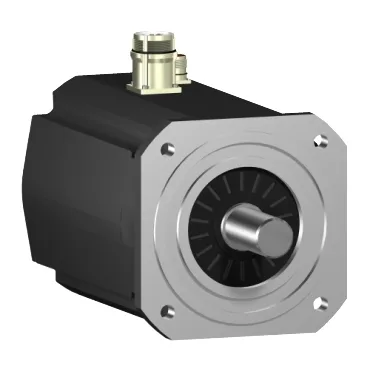
The SH32052P01A1200 is an SH3-series servo motor with sizing reference SH32052P, built for direct mounting on an international-standard flange with a 205 mm motor flange and 180 mm centring collar. In a pulp-and-paper winder, a packaging indexing table, or a press feed — anywhere a gear-head is the wrong answer — this is the class of motor a sizing engineer drops in when the load cycles from hold to high torque several times per minute.
Reading the torque/power envelope against the supply
Nominal torque scales inversely with the DC bus the drive is fed from: 61.6 N·m at 115 V single phase drops to 28.4 N·m at 480 V three phase, while nominal output power peaks at 7980 W at 400 V three phase. Peak stall torque is 220 N·m across the 115…480 V range, so the headroom for step-and-hold moves or short-cycle accelerations is constant — what changes between supplies is the continuous operating point, not the burst ceiling. Continuous stall torque of 64.9 N·m at 25.7 A and copper-hot limit of 130 °C are the two figures to derate against the application's duty cycle; at 400 V three phase the nominal 38.1 N·m sits well under the stall ceiling, leaving margin for short overload events.
Drive sizing from the motor constants
Maximum Irms and 3-second peak current both sit at 96.8 A, so the drive sizing must clear that on the peak axis — a continuous-rated servo amplifier cut to nominal torque will trip on the first accel ramp. Back-EMF constant of 161 V/krpm at 20 °C means the regenerated bus voltage rises with speed; at 2000 rpm this is already roughly 322 V back-EMF, so a 400 V-class drive with adequate brake chopper headroom is the realistic match for the 2000 rpm at 400 V three-phase point. Stator resistance of 0.3 Ω and inductance of 2.95 mH, paired with torque constant 2.52 N·m/A at 120 °C, give the current-loop tuning engineer the per-phase impedance needed to set the drive's Kp/Ki for the 5-pole rotor.
Mechanical integration and shaft-side loads
The 38 mm smooth shaft is 80 mm long and accepts standard shrink-fit couplings or mounted pinions; peak axial load is 740 N, while radial load rises with speed — 2910 N at 3000 rpm is the published lower bound. Mounting holes are 14 mm, centring collar depth is 4 mm — the standard international flange pattern lets the motor bolt up to any common machine-side adapter or gear reducer housing.
Feedback, sealing, and thermal envelope
Feedback is an absolute single-turn SinCos Hiperface encoder terminated in a straight connector — pair this motor with a drive that accepts the Hiperface protocol rather than a resolver or incremental input. Ingress protection is rated IP65 at the motor body and shaft bushing, IP67 at the housing, per IEC 60034-5 — coolant splash and outdoor mounting are within scope, but full submergence is not. Cooling is natural convection with no fan; the 130 °C copper-hot winding limit means the motor relies on its mounting flange and ambient airflow, so a stalled shaft in a still enclosure will thermally fault before it mechanically stalls.