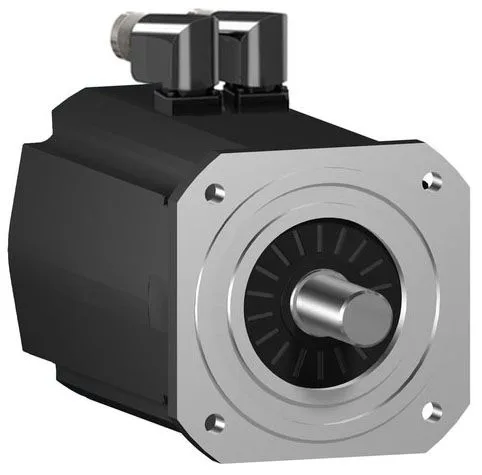
The SH32052P02A2200 is a three-phase servo motor from the SH3 series, rated 7900 W continuous power with a 5-pole design. That pole count means it delivers smooth torque at low speeds without the cogging you'd see in a 2-pole motor — important for positioning applications where the load has to hold still at zero speed. Nominal torque varies with the supply voltage: 61.6 N·m at 115 V single-phase, dropping to 28.4 N·m at 480 V three-phase. Peak stall torque hits 220 N·m across the 115–480 V three-phase range, which is the number to check if your cycle includes a short-duration acceleration or deceleration event that needs extra muscle. The absolute multiturn SinCos Hiperface encoder gives you position feedback without needing a homing cycle on power-up — the motor knows where it is as soon as the drive powers the encoder. That saves a few seconds per power cycle on a machine that gets turned off between shifts.
Speed-torque envelope and drive matching
Nominal speed climbs with supply voltage: 500 rpm at 115 V single-phase, 1000 rpm at 230 V single-phase, 2000 rpm at 400 V three-phase, 2400 rpm at 480 V three-phase. If you're running this on a 480 V three-phase line, the motor wants to spin at 2400 rpm — your VFD's max output frequency and bus voltage need to support that. Continuous stall torque is 64.9 N·m across the 115–480 V three-phase range, and continuous stall current is 25.7 A. That's the thermal limit for holding torque at zero speed — the drive's current loop must be tuned to stay within this when the motor is stalled under load. Stator resistance is 0.3 Ω and inductance is 2.95 mH. These are the numbers the drive's auto-tuning routine needs for current-loop gains. If you swap this motor onto a drive that was tuned for a different winding, expect the current ripple to be off until you re-tune.
Mechanical mounting and environmental sealing
The motor mounts on an international standard flange with a 205 mm flange size, 180 mm centring collar, and 14 mm mounting holes. That's a common pattern — it bolts up to standard gearboxes and mounting plates without adapters. IP65 on the motor body and shaft bushing, IP67 on the housing. The difference matters: IP67 means the housing can be submerged briefly, but the shaft bushing is only IP65, so a direct spray at the shaft seal will eventually get in. Fine for washdown zones; not for continuous submersion. Cooling is natural convection — no external fan. That means the motor relies on airflow around the housing to shed heat. If you're mounting it in a confined space or near heat sources, you'll need to check the thermal rise against the 130°C copper hot-spot limit.
Sourcing — current production, quoted to order
Sourced through independent distribution channels. No stock-holding claim; each order is confirmed per the lot.