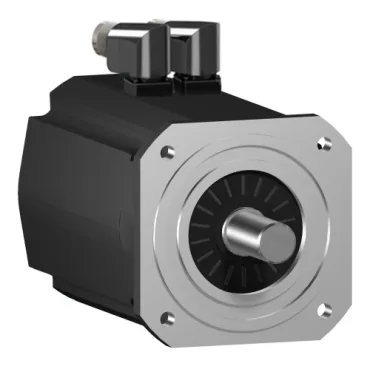
What an existing axis actually gets from this SH3
The SH32052P11A2000 is a Schneider SH3 servo motor in the 205 mm flange size, built on an international standard flange mount with a 14 mm hole pattern, so it drops into the same envelope most retrofit jobs already have on the floor — no need to re-engineer the bracket. It delivers 7900 W continuous and 61.6 N.m nominal at 115 V single phase, scaling through 56 N.m at 230 V single phase, 38.1 N.m at 400 V three phase, and 28.4 N.m at 480 V three phase — meaning the same frame covers a 230 V North American retrofit and a 400 V European line just by selecting the matching drive rail.
Torque envelope across supply rails
Nominal speed shifts with the rail: 500 rpm at 115 V single phase, 1000 rpm at 230 V single phase, 2000 rpm at 400 V three phase, and 2400 rpm at 480 V three phase — a single part number that a panel builder can drop onto a 230 V fan line today and re-rate for a 400 V servo line later without a frame change. Continuous stall torque is rated 574.4 lbf.in (64.9 N.m) across the 115 to 480 V envelope, and the motor holds that torque at standstill with natural convection cooling only — no external fan to mount, route, or filter.
Mechanical and feedback integration
The shaft is 38 mm diameter with an 80 mm length and a 10 mm parallel key, taking radial load up to 4200 N at 1000 rpm and axial load up to 740 N — sized for direct-coupled gearboxes and belt drives on retrofit packaging and converting lines. Feedback is an absolute single-turn SinCos Hiperface encoder, the de-facto standard for Schneider Lexium and legacy servo drive platforms — meet it where the existing drive firmware already is rather than introducing a new comms stack. Sealing is IP54 at the shaft bushing without a seal ring and IP65 on the motor body and shaft bushing per IEC 60034-5; the straight connector termination is the default, with a rotatable right-angled connector available for tight cabinet knockouts.
Drive-side sizing constants
Stator resistance of 0.3 Ohm and stator inductance of 2.95 mH define the current-loop bandwidth the drive must close; the torque constant of 2.52 N.m/A at 120 °C winding gives the amp-per-N.m ratio the drive size must accommodate. Back EMF constant is 161 V/krpm at 20 °C, so the DC-bus ceiling determines the practical field-weakening headroom.
Sourcing posture for a line-down shaft replacement
MOQ and lead time for the 405 mm long, naturally cooled frame are project-dependent and not asserted here.