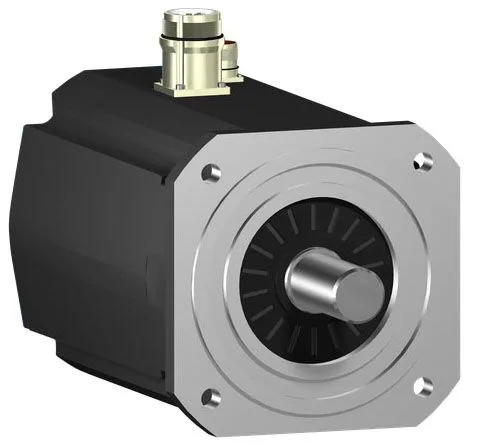
7.9 kW continuous, 2000 rpm at 400 V three-phase
The SH32052P11F1000 is a 7.9 kW continuous power servo motor from the SH3 series, delivering 2000 rpm nominal speed when fed from a 400 V three-phase drive. At 480 V three-phase it runs at 2400 rpm, and at 230 V single-phase it delivers 1000 rpm — the speed follows the applied voltage linearly per the back EMF constant of 161 V/krpm at 20°C. Nominal torque is 61.6 Nm at 115 V single-phase, dropping to 38.1 Nm at 400 V three-phase and 28.4 Nm at 480 V three-phase — the torque curve shifts with the available current from the drive. Peak stall torque reaches 220 Nm across the 115...480 V three-phase range, giving a 3.6× overload margin for acceleration and emergency stops.
Absolute encoder, holding brake, IP65 — what each means for fit
The absolute single-turn SinCos Hiperface encoder reports position at power-up without a homing cycle — critical for applications where the machine must resume from the last known position after a power loss. Single-turn means it tracks one revolution; multi-turn applications need an external battery-backed counter or a multi-turn encoder variant. IP65 on the motor body and shaft bushing means the winding and bearings are protected against dust ingress and low-pressure water jets — suitable for washdown areas and dusty production floors. The IP54 rating on the shaft bushing without the shaft seal ring is a fallback; the IP65 rating applies when the seal ring is fitted, which is the standard configuration for food and beverage or wet machining environments. The 5-pole design gives a lower cogging torque ripple than a standard 4-pole motor, which matters for contouring and surface-finish applications where torque ripple shows up as velocity ripple. Stator inductance is 2.95 mH and resistance is 0.3 Ω — these set the current-loop tuning parameters in the drive; a low-inductance motor like this needs a higher PWM frequency to keep current ripple within the drive's thermal limits.
Mechanical interface — flange, shaft, and connector
The motor mounts on an international standard flange with a 205 mm pilot diameter and a 4 mm centering collar depth. Four 14 mm mounting holes on the flange bolt circle — the bolt pattern matches standard IEC B5 flanges in this frame size. The 38 mm shaft extends 80 mm with a parallel key 10 mm wide — a standard metric keyway for coupling or pulley mounting. Maximum radial force at the shaft end is 4200 N at 1000 rpm, dropping to 2910 N at 3000 rpm; the bearing life follows the cube of the radial load, so a coupling that misaligns by even 0.1 mm reduces the service life significantly. The electrical connection is a rotatable right-angle connector or a straight connector — the rotatable version lets the cable exit in any of four orientations, which simplifies routing in tight cabinets. The connector carries the power, encoder, and brake wires; the brake wires are separate from the motor power leads to avoid induced voltage spikes on the brake coil.