Torque and speed across supply voltages
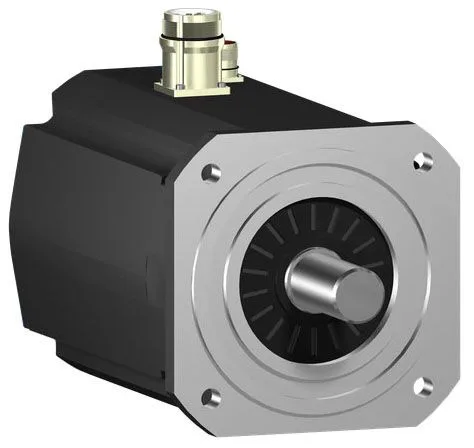
The SH32052P12A1100: This SH3 series servo motor delivers 61.6 Nm nominal torque at 500 rpm on 115 V single-phase input, and 38.1 Nm at 2000 rpm on 400 V three-phase supply. The nominal speed scales with voltage: 500 rpm at 115 V single phase, 1000 rpm at 230 V single phase, 2000 rpm at 400 V three phase, and 2400 rpm at 480 V three phase. That means the same motor frame covers both low-voltage single-phase and line-voltage three-phase installations — the torque curve shifts with the applied voltage, so the drive tuning needs to account for the supply you actually have on the panel. Peak stall torque hits 220 Nm across the 115...480 V three-phase range, with continuous stall torque at 64.9 Nm under the same conditions. The continuous power rating is 7900 W, but the nominal output power varies from 3230 W at 115 V single phase up to 7980 W at 400 V three phase. If you are sizing for a 480 V line, expect 7140 W nominal — the motor is slightly derated at the top end of the voltage range.
Feedback and electrical parameters for servo tuning
The encoder is an absolute multiturn SinCos Hiperface type — that gives you position at power-up without a homing cycle, and the sine-cosine signals let the drive interpolate for fine resolution. The torque constant is 2.52 Nm/A at 120 °C copper temperature, and the back EMF constant is 161 V/krpm at 20 °C. Stator resistance is 0.3 Ohm and inductance is 2.95 mH — these are the numbers you feed into the servo drive autotuning routine for current loop gains.
Mechanical interface and environmental sealing
The motor mounts on an international standard flange with a 205 mm flange size and a 180 mm centring collar diameter. The shaft is 1.5 inches (38 mm) diameter with a parallel key, 80 mm shaft length, and 10 mm key width. Maximum radial force at the shaft nose is 4200 N at 1000 rpm, dropping to 2910 N at 3000 rpm — if you are coupling to a belt drive or a high-overhung-load application, stay inside those limits to avoid bearing damage. IP65 protection on both the motor body and the shaft bushing, conforming to IEC 60034-5. That means it is sealed against dust ingress and low-pressure water jets — suitable for washdown environments in food processing or packaging lines. Cooling is by natural convection, so no fan or external blower is needed; just make sure there is enough free air around the motor body to dissipate the 7900 W continuous losses.