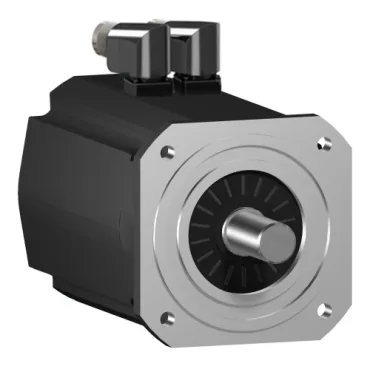
Speed, torque, and power across the voltage rails
The SH32052P12A2100: Continuous power is listed at 7900 W and peak stall torque reaches 1947.2 lbf·in (220 N·m) across the 115 to 480 V envelope — meaning the drive has to be sized for both the 220 N·m transient (machine presses, indexed stops) and the 64.9 N·m continuous stall, not just the headline kW figure. Maximum current (Irms) and 3-second peak output current both sit at 96.8 A, so the drive's current loop has to deliver that ceiling without saturating on the worst acceleration step; torque constant is 2.52 N·m/A at 248 °F (120 °C) winding, the condition under which the constant is specified.
Mechanical envelope and shaft load
Shaft interface is a parallel-key 1.5 in (38 mm) diameter shaft with a 3.1 in (80 mm) length and a 0.4 in (10 mm) key — the motor mounts to a 205 mm international-standard flange with 0.6 in (14 mm) mounting holes and a 7.09 in (180 mm) centring collar, 4 mm deep. Maximum radial force is rated 4200 N at 1000 rpm, 3330 N at 2000 rpm, and 2910 N at 3000 rpm — the load envelope drops as speed rises, so a belt or pinion mounted outboard has to stay within those curves or bearing life goes first; maximum axial force is 740 N. Body length is 15.9 in (405 mm) and the encoder is an absolute multiturn SinCos Hiperface device, which means the drive side has to support Hiperface protocol over the signal cable — pairing it with a non-Hiperface drive leaves the position feedback dead even though the power stage runs.
Thermal envelope and environmental rating
IP65 is held on both the motor body and the shaft bushing per IEC 60034-5, meaning the motor tolerates water jets and dust ingress — it's appropriate for washdown-adjacent or outdoor cabinet duty, not submersion, and the shaft seal is the wet-end barrier that has to be checked at every servicing interval.
Sourcing posture for this code
Electrical connection is offered as either a straight connector or a rotatable right-angled connector — the right-angle option exists for cabinets where the cable has to exit along the shaft axis, and either way the connector family is the same mating set on the drive-side cable.