Motor form factor and mounting constraints
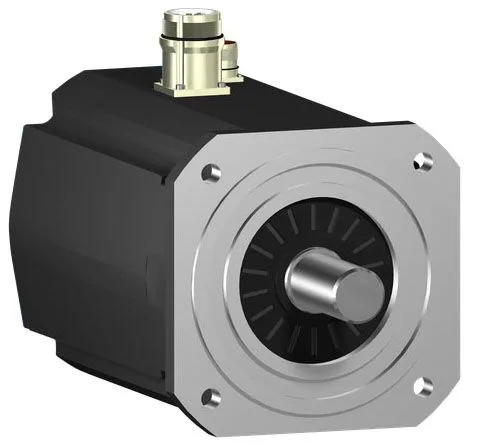
The SH32052P12F1100: This SH3-series servo motor uses an international standard flange with a 205 mm bolt circle and four 14 mm mounting holes. The centring collar depth is 4 mm, so the pilot register on the mating machine frame must match that depth to avoid axial misalignment. Overall length is 454.5 mm from the mounting face to the rear of the housing. The shaft is 38 mm diameter with a 10 mm keyway and 80 mm shaft extension — parallel key. That shaft length gives enough engagement for a standard coupling or pulley hub, but check the keyseat depth against your hub bore before committing. Two electrical connection options are listed — a rotatable right-angled connector and a straight connector. The rotatable version helps when cable routing is tight against the machine frame; the straight connector suits through-panel or drag-chain installations where the cable exits axially.
Speed-torque envelope — what the supply voltage buys you
This is a three-phase motor, but the nominal speed and torque depend heavily on the supply you feed it. At 115 V single-phase, nominal speed is 500 rpm with 61.6 Nm torque and 3230 W output. Step up to 230 V single-phase and you get 1000 rpm, 56 Nm, 5860 W. On 400 V three-phase, it delivers 2000 rpm, 38.1 Nm, 7980 W. At 480 V three-phase, 2400 rpm, 28.4 Nm, 7140 W. Peak stall torque is 220 Nm across the 115...480 V three-phase range, with a peak current of 96.8 A. The torque constant is 2.52 Nm/A at 120 °C copper temperature, and the stator resistance is 0.3 Ohm with 2.95 mH inductance. The back EMF constant is 161 V/krpm at 20 °C. These numbers let you calculate the drive voltage headroom needed to reach full speed under load — at 2000 rpm the back EMF is about 322 V, so a 400 V bus has roughly 78 V margin before the drive hits its voltage limit.
Encoder, brake, and environmental sealing
The encoder is an absolute multiturn SinCos Hiperface type — this gives position feedback even after power loss, and the SinCos analog track provides high-resolution velocity feedback for the drive's servo loop. No homing sequence needed on power-up, which saves cycle time in multi-axis pick-and-place or rotary indexing applications. A holding brake is fitted with 80 Nm holding torque. That's enough to hold a vertical load with a 2:1 safety factor against the motor's continuous stall torque of 64.9 Nm. The brake engages when power is removed — it's a spring-set, electrically released type, so the load stays put during an E-stop or power loss. IP65 protection on both the motor body and the shaft bushing per IEC 60034-5 — the motor withstands hose-directed water and dust ingress. The connector O-ring is the wet-end seal, not the housing thread — make sure the mating cordset has a matching IP65 rating.
Sourcing and lifecycle — active production
No stock-holding claim; each order is placed against the manufacturer's production schedule.