Voltage-dependent duty envelope — read the supply before sizing the gearbox
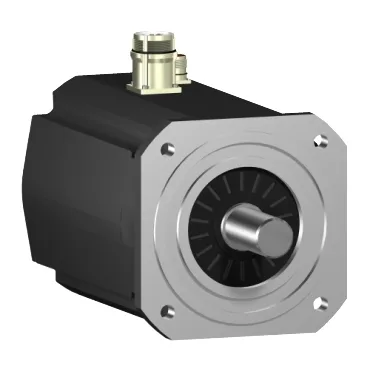
The Schneider Electric SH32053P01A1000 is a three-phase servo motor in the SH3 family, sized against reference SH32053P (device short name SH3), and its continuous duty shifts substantially with the drive supply it is paired to. Nominal torque lands at 84.9 N·m on 115 V single-phase, drops to 74.4 N·m on 230 V single-phase, then to 50.7 N·m on 400 V three-phase and 40.2 N·m on 480 V three-phase; nominal speed climbs in the opposite direction from 500 rpm to 2400 rpm across the same four supplies. The so-what for a machine designer: the headline 84.9 N·m figure only applies on 115 V single-phase operation, where the unit also delivers its lowest continuous power of 4450 W. Across the same physical motor the 400 V three-phase operating point gives 50.7 N·m at 2000 rpm and 10620 W of mechanical output — almost the inverse relationship, so the drive rating and mains tap decide which point on the family envelope the motor actually runs at.
Stall, peak, and current ceiling — sizing the drive amplifier
Continuous stall torque is 94.4 N·m across 115–480 V three-phase, paired with a continuous stall current of 33.2 A; peak stall torque reaches 330 N·m for short-duration accelerations and the maximum permissible Irms is 136.1 A, which sets the drive amplifier's current limit. Stator winding resistance is 0.2 Ω and stator inductance is 6.3 mH — the L/R time constant governs how aggressively the servo drive can ramp current into the winding during a step command.
Encoder feedback and electrical connection
Feedback is an absolute single-turn SinCos Hiperface encoder, which gives one absolute position per mechanical turn with sine/cosine incremental tracks and the Hiperface parameter channel for electronic nameplate read-back — this lets the drive load motor and encoder constants on first power-up without manual entry. The motor ships without a holding brake, so any safety-stop holding duty has to be provided by the driven load, a shaft-mounted external brake, or a second servo on the same axis. Electrical connection is either a rotatable right-angled connector or a straight connector — both options are listed on this code, so the same order code covers cabinet layouts that need a low-profile cable exit and ones where the cable must drop straight out of the back of the motor. Temperature class is 130 °C copper hot, which is the standard 'B/F' rise envelope for industrial servo duty.
Mechanical envelope and shaft loading
The motor is built on an international standard flange with a 205 mm flange size, a 180 mm centring collar with 4 mm depth, four 14 mm mounting holes, and a 38 mm diameter smooth shaft 80 mm long with an overall motor length of 489 mm. Maximum mechanical speed is 3800 rpm — above the 2400 rpm nominal on 480 V three-phase, but well short of the duty point on 115 V single-phase, where 500 rpm sits far below the mechanical limit. Shaft loading limits are 740 N maximum axial force and 4500 N maximum radial force at 1000 rpm, falling to 3570 N at 2000 rpm and 3120 N at 3000 rpm — so any direct-coupled gearbox or belt drive has to be checked at its operating rpm, not just the catalogue headline. Cooling is natural convection with no integrated fan, which means the IP65 sealing holds but the motor relies on its mounting surface and surrounding cabinet air for heat rejection.
Sealing for plant environments
Ingress protection per IEC 60034-5 is IP54 at the shaft bushing without a shaft seal ring, and IP65 at both the motor housing and the shaft bushing when the seal ring is fitted — so this order code clears washdown and dusty cell environments provided the shaft seal option is specified at order entry. IP65 with natural convection is the standard industrial-servo envelope: sealed against low-pressure water jets and particulate, with no forced-air path that would pull contamination into the windings.
Sourcing posture for an active SH3 servo
The lifecycle entry reads as current production, so this code is sourced to order through independent distribution rather than brokered out of a last-time-buy window. With 10620 W of continuous mechanical output on 400 V three-phase and 330 N·m peak torque, this is a heavy-duty machine-axis motor rather than a commodity spare, so spec the drive pairing, encoder cable, and connector orientation before committing the line.