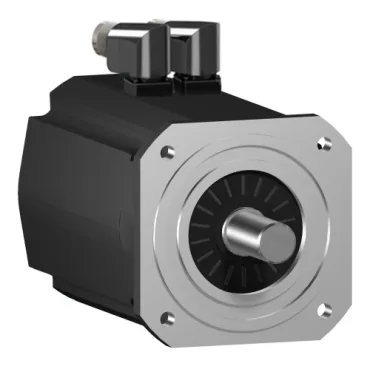
Sizing the drive against the SH3 envelope
SH32053P01A2200 is the SH32053P frame in the SH3 family — a three-phase servo sized for the 400 V industrial bus, where it delivers 10620 W nominal output and 448.7 lbf.in (50.7 N.m) of nominal torque at 2000 rpm. Drop the supply to 115 V single-phase and the same motor trades speed for torque, producing 751.4 lbf.in (84.9 N.m) at 500 rpm — useful on legacy machine taps where the cabinet transformer cannot feed 480 V three-phase. Peak stall reaches 2920.7 lbf.in (330 N.m) on the 115–480 V envelope, with continuous stall torque held at 835.5 lbf.in (94.4 N.m) and continuous stall current 33.2 A — so the drive sizing must respect the continuous figure, not the peak, when budgeting the amplifier rating. Irms ceiling is 136.1 A, which is the dynamic braking and short-term overload gate, not the steady-state target.
Feedback, shaft, and connector integration
Feedback is the absolute single-turn SinCos Hiperface protocol — a resolver-class absolute encoder that returns one-revolution position plus sine/cosine incremental tracks for high-resolution interpolation, typically paired with Schneider Electric / Lexium-series drives in this frame. Power and signals exit through a rotatable right-angled connector, so the cable gland can be clocked to the cabinet layout without re-routing the loom. The shaft is 38 mm diameter by 80 mm long with a smooth finish and no holding brake — the buyer supplies the brake externally if the axis needs to hold position with the bus de-energised, which is typical for vertical or suspended loads. Sealing is IP65 on the motor body and shaft bushing plus IP67 on the housing per IEC 60034-5, so the motor tolerates washdown environments such as food-and-beverage conveyors or outdoor skids, provided the mating connector is also sealed to the same class.
Mounting footprint and shaft loads
The motor drops onto an international standard flange with a 205 mm flange, 180 mm centring collar, and 4 through-holes at 14 mm diameter — a common footprint in this power class that mates with NEMA-style reduction gearboxes and most metric machine faces. Centring collar depth is 4 mm, which sets the pilot engagement the gearbox expects. Maximum axial force is 740 N and maximum radial force derates with speed — 4500 N at 1000 rpm, 3570 N at 2000 rpm, and 3120 N at 3000 rpm — so a belt drive or pinion mounted near the shaft end has to be sized against the curve, not against a single headline figure. Overall length is 19.3 in (489 mm), which matters for cabinet depth and shaft-coupling alignment.
Thermal envelope and electrical constants
Cooling is natural convection — no fan, no liquid loop — so the thermal ceiling is the 266 °F (130 °C) copper hot-spot figure, and the continuous ratings assume that envelope is held by the surrounding cabinet airflow. Stator resistance is 0.2 Ohm with 6.3 mH inductance, the torque constant is 2.76 N.m/A referenced to 248 °F (120 °C), and the back EMF constant is 172 V/krpm at 68 °F (20 °C) — three numbers the drive commissioning profile uses to model the motor before the first motion command.
Sourcing posture for the BOM line
Independent distribution is the way in for non-standard quantities, and pricing is confirmed against the BOM at RFQ rather than off a published price ladder.