What it is and how it sits on the panel
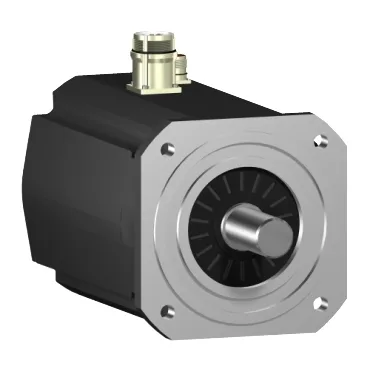
The Schneider Electric SH32053P01F1200 is a member of the SH3 family of three-phase AC servo motors, sized against the SH32053P reference frame, built around an 8.07 in (205 mm) international-standard flange with a 1.5 in (38 mm) smooth shaft protruding 3.1 in (80 mm). Total motor length is 21.2 in (538.5 mm), and the four 0.6 in (14 mm) mounting holes are arranged on the 7.09 in (180 mm) centring-collar register, so it drops onto the same gearbox and planetary-gearhead mounting pattern used across the SH3 range.
Torque and power envelope across mains voltages
Holding torque is 708.06 lbf.in (80 N.m) and the motor delivers its continuous 10,600 W over a four-point speed/voltage map: 500 rpm at 115 V single-phase rising to 2,400 rpm at 480 V three-phase. Peak stall torque reaches 2,920.7 lbf.in (330 N.m) and continuous stall torque is 835.5 lbf.in (94.4 N.m), both rated across the full 115–480 V window — useful sizing headroom for short-cycle accel/decel profiles typical of indexing tables and packaging axes. Continuous stall current of 33.2 A and maximum Irms of 136.1 A define the drive sizing envelope on the controller side.
Feedback, brake and electrical interface
A holding brake is fitted, supplied through the same straight connector that carries the power leads, so the brake release is wired back to the drive's dedicated brake output rather than to an external contactor. Cooling is natural convection — no fan, no forced-air ducting — which keeps the cabinet-side integration to the flange footprint and the centring collar, with no clearance envelope for airflow beyond what the IP65 housing already requires. The motor carries five poles on the three-phase stator.
Shaft loading, thermal limits and environment
Shaft load limits are quoted at 4,500 N radial at 1,000 rpm, dropping to 3,570 N at 2,000 rpm and 3,120 N at 3,000 rpm; maximum axial force is 740 N. These figures govern belt, pinion and coupling choice — the radial envelope in particular falls off with speed because the bending mode of the shaft dominates the allowable load as RPM climbs, and a timing-belt or helical pinion should be selected so the working point sits well inside the curve at the application's nominal rpm.