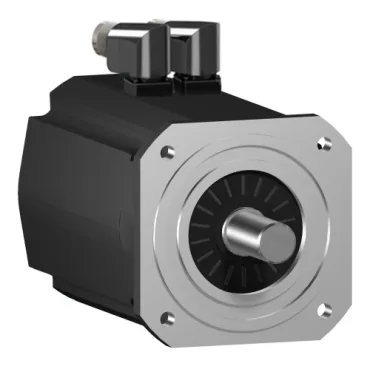
Where the SH3 80 N.m fits on the line
The SH32053P01F2000 is a Schneider Electric SH3 three-phase servo motor sized at 80 N.m of holding torque with a 205 mm international-standard flange, and it is built to drop into the mid-bracket of a high-inertia machine axis where the gearbox, conveyor, or indexing table asks for both continuous torque and a meaningful peak margin. Its continuous output ranges from 4450 W on a 115 V single-phase drive up to 10620 W on a 400 V three-phase drive, which means the same frame delivers very different mechanical headroom depending on which supply the cabinet feeds it — the 400 V three-phase envelope is the one that unlocks the 80 N.m holding figure in continuous duty.
Speed, torque, and the voltage-dependent envelope
Nominal speed scales with the drive rail: 500 rpm at 115 V single-phase, 1000 rpm at 230 V single-phase, 2000 rpm at 400 V three-phase, and 2400 rpm at 480 V three-phase. The matching nominal torque figures (84.9 N.m down to 40.2 N.m) drop as the speed climbs, which is the constant-power shape typical of a servo envelope where torque is traded against speed across the field-weakening range. Peak stall torque is rated at 330 N.m across the 115–480 V window and continuous stall torque holds at 94.4 N.m across the same range, so the motor carries roughly a 3.5× overload margin between continuous stall and peak — the figure an integrator checks when sizing acceleration transients on a vertical or high-inertia load. Back-EMF constant is 172 V/krpm at 20 °C and the torque constant is 2.84 N.m/A at 120 °C winding temperature; together those values let the drive commissioning tool predict the bus current a given torque command will pull, which matters most when the amplifier and the motor are tuned together rather than swapped out independently.
Feedback, brake, and shaft mechanicals
Position feedback is an absolute single-turn SinCos Hiperface encoder — the standard pairing for a Schneider Lexium or equivalent drive that expects Hiperface comms over the same cable as the motor power, which keeps the cabinet wiring to a single connector run per axis. The motor ships with an integrated holding brake and is cooled by natural convection, so it has to be mounted where its own frame can shed heat — a sealed cabinet with no airflow around the servo body will erode the continuous rating the spec table promises. Shaft is 38 mm diameter, 80 mm long, smooth with a 180 mm centring collar on a 205 mm flange using 14 mm mounting holes; maximum radial load is 4500 N at 1000 rpm, dropping to 3120 N at 3000 rpm, and maximum axial load is 740 N — those are the load envelopes a gearbox or coupling designer has to respect, especially on belt- or pinion-driven axes where radial force grows with speed.
Sealing, connector, and what the cabinet sees
Ingress protection is IP54 at the shaft bushing without a seal ring, IP65 on the shaft bushing with the seal, and IP65 on the motor body to IEC 60034-5 — adequate for a washdown-adjacent food-and-bev cell or an outdoor enclosure when the shaft seal is fitted, but not a fully sealed submersible unit. Electrical connection is available as either a straight connector or a rotatable right-angled connector, which gives the panel builder a way to dress the cable exit along the cabinet trunking without a separate adapter — the choice is usually made at order entry rather than in the field.
Sourcing posture for the SH32053P01F2000
Lifecycle status is recorded as current and the part ships as a single unit per package; there is no official second source or successor cross-reference on the record, so the procurement decision sits with confirming the drive-side firmware pairing and the connector variant before the BOM line freezes.