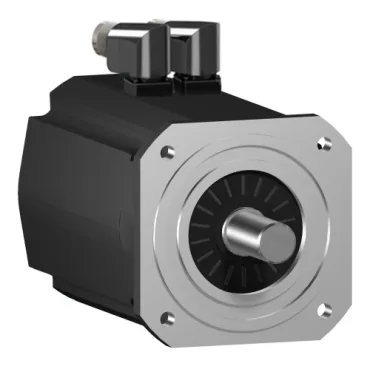
What you are mounting in the panel
The SH32053P01F2200: It is 21.2 in (538.5 mm) long end-to-end and carries an 8.07 in (205 mm) international-standard flange with a 7.09 in (180 mm) centring collar seated 0.2 in (4 mm) deep — the bolt circle drops into a standard IEC mounting footprint without an adapter plate. The shaft side is a 1.5 in (38 mm) smooth shaft, 3.1 in (80 mm) long, so coupling selection has to clear that exposed length and reach into the driven load without bottoming out in the shaft seal.
Torque, speed and where this motor actually lives on the curve
Continuous output power scales the same way: 4450 W at 115 V single-phase, 7790 W at 230 V single-phase, 10620 W at 400 V three-phase, and 10100 W at 480 V three-phase, with the listed continuous power figure of 10600 W landing on the three-phase 400 V operating point.
Electrical constants the drive needs to know
Stator resistance is 0.2 Ohm with a stator inductance of 6.3 mH; continuous stall current is 33.2 A and maximum current Irms is 136.1 A, so the drive sizing needs roughly four times the continuous current in peak headroom for short-duration accelerations. The winding is a five-pole design and the motor carries three-phase power — a standard drive bus, with no special phase-count configuration required at commissioning.
Encoder, brake and connection side
The integrated holding brake is fail-safe and only intended to lock the shaft at standstill; it is not a dynamic braking device, so decelerating a high-inertia load still has to be handled by the drive's regen circuit or an external braking resistor. The electrical interface is a rotatable right-angled connector, which lets the wireman orient the cable gland along the most convenient axis of the cabinet after the motor is bolted down — useful when the cable drop has to clear an adjacent drive or a cable tray edge.
Thermal envelope, sealing and mechanical load limits
Cooling is natural convection — no integrated fan, so the motor relies on its mounting surface and surrounding panel air to reject heat; in a sealed cabinet this drives the ambient-temperature derating rather than allowing a fan-cooled continuous rating. The motor body is IP65 to IEC 60034-5, the shaft bushing is IP65, and the housing seal is IP67 — that is sufficient for washdown-adjacent deployments and outdoor cabinets with indirect spray, but the shaft seal is the wear item that eventually limits the wet-side rating in service. Maximum radial force on the shaft is 4500 N at 1000 rpm, 3570 N at 2000 rpm, and 3120 N at 3000 rpm, with a maximum axial force of 740 N — belt-driven loads have to be checked against the right rpm row of that table, and overhung pinion loads above 3000 rpm need a separate calculation.
Lifecycle read and how to put it on a PO
Pricing and availability are quoted to order against the RFQ: lead time and quantity breaks come back from the desk once the order code and quantity are on the line, and traceability is documented against the manufacturer packing slip at shipping.