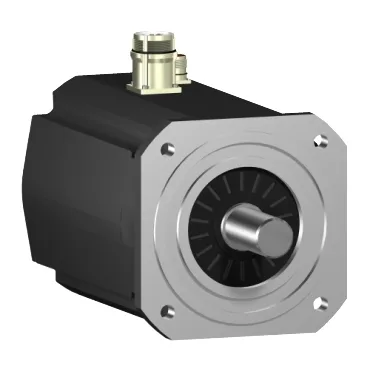
Mechanical envelope: flange, shaft, and overall length
The SH32053P02A1100: The 205 mm international-standard flange (8.07 in) mounts through four 14 mm holes on a 180 mm centring collar, with a 4 mm collar depth for pilot alignment — the standard pattern this drive family mates to. Shaft is smooth, 38 mm diameter and 80 mm long, total length 489 mm — designed to take a servo coupling directly without a keyway modification.
Power, torque, and the multi-voltage speed map
Continuous power is 10.6 kW and the motor is listed at 10.62 kW nominal output on 400 V three-phase — the headline figure the drive sizing calculation is built around. Nominal torque swings with the supply rail: 84.9 N·m at 115 V single-phase, falling to 40.2 N·m at 480 V three-phase as the nominal speed climbs from 500 rpm to 2400 rpm — same motor, four different operating points. Peak stall torque reaches 330 N·m across the full 115–480 V range — the short-duration overload ceiling that defines the machine's acceleration capability. Continuous stall torque is 94.4 N·m and continuous stall current is 33.2 A, with a peak Irms of 136.1 A — the amp figure the drive's current loop has to deliver on transient demand.
Feedback, sealing, and thermal headroom
Feedback is an absolute multiturn SinCos Hiperface encoder — the protocol used across the Schneider SH3 family — wired through either a rotatable right-angled or straight connector depending on cabinet routing. IP65 is maintained on both motor body and shaft bushing per IEC 60034-5, so the unit tolerates washdown and dust-laden industrial environments; cooling is natural convection with no integrated fan to fail. Thermal envelope allows the copper to run to 130 °C, with torque constant specified at 2.76 N·m/A at 120 °C — the operating-point figure used in torque-constant-based drive commissioning. Stator resistance is 0.2 Ω and inductance 6.3 mH; back-EMF constant 172 V/krpm at 20 °C — these are the values that size the drive's current-loop bandwidth and bus-voltage headroom.
Load limits on shaft and bearings
Maximum axial load is 740 N; radial load is 4500 N at 1000 rpm, dropping to 3570 N at 2000 rpm and 3120 N at 3000 rpm — the curve the gearbox or coupling selection has to respect. Mechanical speed ceiling is 3800 rpm — well above the 2400 rpm electrical nominal at 480 V, so the shaft can be pushed through a temporary overspeed without immediate mechanical concern, but the bearing life budget still applies.