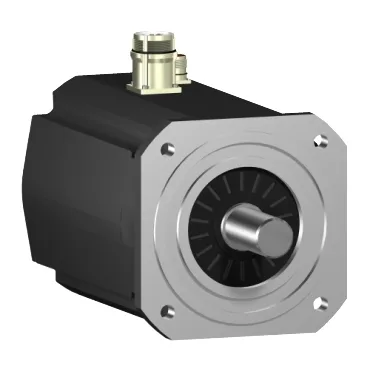
What kind of axis does this motor actually drive?
The SH32053P02A1200 is a Schneider Electric SH3 series three-phase servo motor sized at 10600 W continuous, with a 205 mm international-standard flange and an absolute multiturn SinCos Hiperface encoder on a smooth 38 mm shaft — the configuration most integrators reach for on a high-inertia indexing or web-tension axis where absolute position retention survives a power cycle.
Why the four-row nominal table matters more than the headline wattage
Continuous power varies with the bus the drive is run from — 4450 W at 115 V single phase, 7790 W at 230 V single phase, 10620 W at 400 V three phase, 10100 W at 480 V three phase — which is why the 10600 W figure on the spec row is the three-phase 400 V operating point, not a universal number. Nominal torque follows the same pattern and inverts with voltage: 84.9 N·m at 115 V single phase drops to 40.2 N·m at 480 V three phase, because the higher nominal speeds (2000 rpm at 400 V, 2400 rpm at 480 V) trade torque for top-end velocity on the constant-power region. Back EMF constant of 172 V/krpm at 20 °C and a torque constant of 2.84 N·m/A at 120 °C copper temperature are the two numbers the drive commissioning engineer cross-checks against the amplifier's bus voltage and current-loop gain before the first saturation test.
Peak versus continuous — which rating actually governs sizing
Peak stall torque reaches 330 N·m across the 115–480 V range, against 94.4 N·m continuous stall torque at the same envelope — roughly 3.5× overload headroom for short acceleration steps, the figure the sizing engineer uses for the worst-case move profile. Peak current Irms of 136.1 A and continuous stall current of 33.2 A set the same ratio on the electrical side; the drive's peak-current window must be sized to deliver the 3-second peak without tripping, while the root-mean-square current over the duty cycle must stay below the 33.2 A continuous figure to avoid thermal cutback. Stator resistance 0.2 Ohm and stator inductance 2.05 mH are the loop-tuning inputs the current regulator uses to set bandwidth — the low L/R ratio (~10 ms electrical time constant) is typical of this frame size and lets the drive push the velocity loop higher than a high-inductance servo.
Where the SH3 fits in a real cabinet — flange, shaft, sealing
Mounting is the international-standard flange pattern with a 205 mm motor flange, 180 mm centring collar with 4 mm depth, and 14 mm mounting holes — drop-in for the standard 200 mm-frame machine-builder baseplate. Overall length is 489 mm with a 80 mm shaft extension of 38 mm diameter, so the mechanical designer has to budget the cantilever load against the published radial/axial limits: 4500 N radial at 1000 rpm, derating linearly to 3120 N at 3000 rpm, with 740 N maximum axial force. Ingress protection is IP65 on the motor body and shaft bushing plus IP67 on the housing, all per IEC 60034-5 — adequate for a washdown-adjacent food line or outdoor cell, and the cooling method is natural convection with a 130 °C copper-hot thermal limit, so no external fan or blower duct is needed in the cabinet layout.