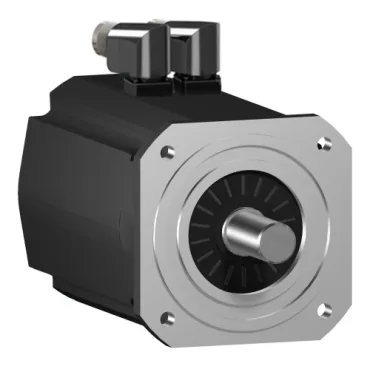
What this motor is on the BOM
The SH32053P02A2000 is an SH3-series three-phase servo motor built around a 205 mm international-standard flange and a 19.3 in (489 mm) body — sized for mid-range machine axes where a servo drive commands torque and speed rather than a simple V/Hz profile. Feedback is an absolute multiturn SinCos Hiperface encoder on a 38 mm smooth shaft, so the drive gets absolute position from power-on without a homing cycle on every restart — a meaningful difference on machines with long travels or vertical axes that cannot drift on power-up. Cooling is natural convection (no integrated fan), and the housing is IP54 at the shaft bushing without a seal ring, IP65 on the motor body, and IP65 on the shaft bushing when the seal option is fitted to IEC 60034-5 — so the standard build is suited to cabinet interiors or clean industrial cells, not outdoor or washdown duty without the seal upgrade.
Torque, speed and the supply ladder that picks the operating point
Continuous torque scales inversely with supply voltage: 751.4 lbf.in (84.9 N.m) at 115 V single-phase, 658.5 lbf.in (74.4 N.m) at 230 V single-phase, 448.7 lbf.in (50.7 N.m) at 400 V three-phase, and 355.8 lbf.in (40.2 N.m) at 480 V three-phase — the same stator delivers less continuous torque as the bus voltage climbs because the allowable current envelope is reached sooner. Continuous output power tracks the same ladder — 4450 W at 115 V single-phase, 7790 W at 230 V single-phase, 10620 W at 400 V three-phase, and 10100 W at 480 V three-phase — with the 10600 W continuous power rating sitting on the 400 V three-phase operating point as the headline figure. Peak stall torque reaches 2920.7 lbf.in (330 N.m) across the 115–480 V range, with continuous stall torque at 835.5 lbf.in (94.4 N.m) and continuous stall current of 33.2 A — the motor's overload headroom is roughly 3.5× continuous torque for short accel/decel moves, which sets the size of the drive's current limit block.
Electrical constants the drive has to be sized against
Back EMF constant of 172 V/krpm at 68 °F (20 °C) and torque constant of 2.84 N.m/A at 248 °F (120 °C) tell the drive how the motor converts current to torque and how fast it generates voltage as it spins — the drive's DC bus must stay well above the back-EMF at top speed, otherwise the current controller runs out of headroom and torque collapses. Stator resistance is 0.2 Ohm and stator inductance is 2.05 mH; maximum RMS current is 136.1 A with a 3 s peak output current also at 136.1 A — these are the figures the servo drive's current loop bandwidth and IGBT sizing are matched to.
Mechanical interface and the loads it can carry
The shaft is 1.5 in (38 mm) diameter, 3.1 in (80 mm) long, smooth (no keyway), and the centring collar is 7.09 in (180 mm) diameter by 0.2 in (4 mm) deep — a heavy-duty shaft sized for direct coupling to gearboxes, large pinions, or planetary reducers rather than a small pinion pressed on a keyed shaft. Maximum radial force Fr derates from 4500 N at 1000 rpm to 3570 N at 2000 rpm and 3120 N at 3000 rpm — pushing the motor faster than its nominal speed range pulls the allowable belt or pinion load down, and any overhung load calculation has to use the value that matches the actual operating speed, not the headline number. Electrical hook-up is via a straight connector, with a rotatable right-angled connector as the alternative — the rotatable variant exists so the cable can be dressed out at 90° to the motor axis where the cable run would otherwise foul the coupling or the machine frame.
Production status and how the part is supplied
There is no official L*-recorded successor or second source on the ledger, and no peer cross-reference on file — for BOM planning this means the SH32053P02A2000 stands as the sole coded part in this build, and a design-in should treat it as single-source until the project records a qualified alternate.