Supply-dependent performance — the spec that decides the drive match
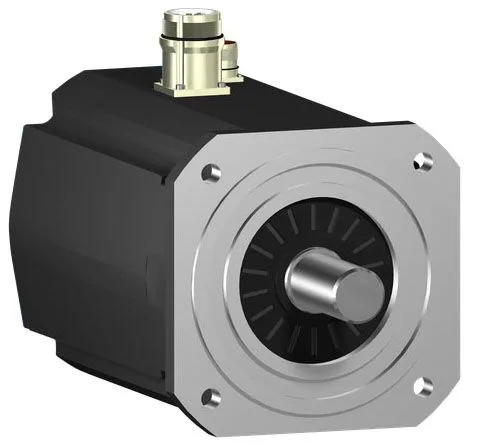
The SH32053P11F1000: This motor's nominal torque, speed, and output power all shift with the supply voltage and phase configuration — it's not a single-rating part. At 115 V single phase, nominal torque is 84.9 Nm at 500 rpm, delivering 4450 W. On 400 V three-phase, torque drops to 50.7 Nm but speed climbs to 2000 rpm, output 10620 W. On 480 V three-phase, nominal torque is 40.2 Nm at 2400 rpm, output 10100 W. Peak stall torque is 330 Nm across the 115–480 V three-phase range, and continuous stall torque is 94.4 Nm. The holding brake delivers 80 Nm — enough to hold the load at rest but well below the motor's peak capability, so don't rely on it for emergency stopping under full load. Continuous power is 10600 W, with a maximum current Irms of 136.1 A (3s peak same value). The stator resistance is 0.2 Ohm and inductance 2.05 mH — these numbers feed the drive's autotune and current-loop gain settings.
Shaft and encoder — what bolts on and what talks to the drive
Shaft diameter is 38 mm with a parallel key (key width 10 mm), shaft length 80 mm. The motor flange is 205 mm (IEC standard flange). Centring collar depth is 4 mm — verify the mating pilot bore depth on your existing mount. Encoder is an absolute single-turn SinCos Hiperface — this is a proprietary feedback protocol that requires a compatible drive (Kollmorgen AKD or third-party with Hiperface interface). The rotatable right-angled connector (or straight connector option) gives some cable-exit flexibility in tight enclosures.
Environmental protection and mechanical limits
IP rating depends on the shaft seal configuration: IP54 at the shaft bushing without a seal ring, IP65 for the motor body and with the shaft seal ring fitted. If this motor goes into a washdown area, specify the shaft seal ring option — the base IP65 motor rating is fine for the housing, but the shaft exit is the leak path. Maximum radial force Fr is 4500 N at 1000 rpm, derating to 3120 N at 3000 rpm. Maximum axial force Fa is 740 N. These limits govern belt-drive or overhung-load applications — a direct coupling is preferred to avoid exceeding the bearing ratings. Cooling is natural convection — no fan, so the motor relies on its own surface area and the mounting flange for heat dissipation. The copper hot-spot temperature is 130 °C. In a confined cabinet or high-ambient environment, check the thermal derating against the continuous torque curve.