Motor specs for the BOM line
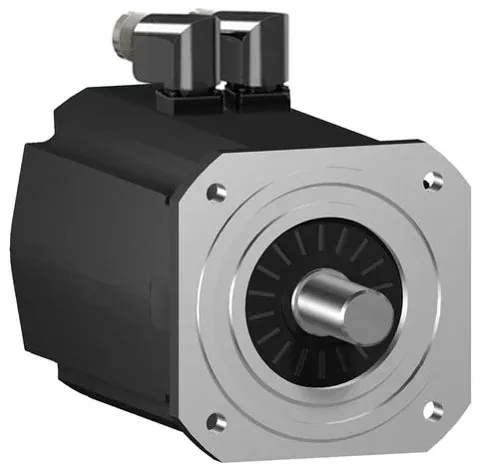
The SH32053P11F2100 is a three-phase servo motor from the SH3 series, delivering 10,600 W continuous power and a nominal torque of 751.4 lbf·in (84.9 N·m) at 115 V single-phase, stepping to 448.7 lbf·in (50.7 N·m) at 400 V three-phase. Peak stall torque hits 2920.7 lbf·in (330 N·m) across 115–480 V three-phase, with a continuous stall torque of 835.5 lbf·in (94.4 N·m) — the motor can hold that torque indefinitely without overheating, which matters for clamping or indexing applications. The holding brake delivers 708.06 lbf·in (80 N·m) — enough to lock the shaft on a vertical axis when power is removed. If your application needs a brake, this motor has it integrated; no separate brake module needed.
Signal integrity and encoder choice
Encoder is an absolute single-turn SinCos Hiperface — that means you get position feedback at power-up without a homing cycle, and the SinCos analog track gives fine interpolation for high-resolution velocity control. The signal is differential, so it rejects common-mode noise from VFD cables as long as the shield is bonded at the drive end. Stator resistance is 0.2 Ω and inductance 2.05 mH — low enough that peak current (136.1 A for 3 s) can rise fast, but the drive's current loop tuning needs to account for the L/R time constant. Check the shield first if you see position jitter; the Hiperface link is sensitive to ground loops.
Mounting and mechanical integration
Mounts to an international standard flange (size 205 mm flange, 8.07 in) with a centring collar depth of 0.2 in (4 mm) and four 14 mm mounting holes. The shaft is 1.5 in (38 mm) diameter with a parallel key, 3.1 in (80 mm) long — standard for coupling to a gearbox or pulley. Overall length is 21.2 in (538.5 mm). The electrical connection comes as a straight connector or a rotatable right-angled connector — choose the one that fits your cable routing without a tight bend radius. IP65 rating on the motor and shaft bushing per IEC 60034-5 means it handles washdown and airborne dust — fine for food processing or machining centres, but not submersion. Cooling is natural convection, so keep the ambient airflow clear of obstructions.