Motor ratings across supply voltages
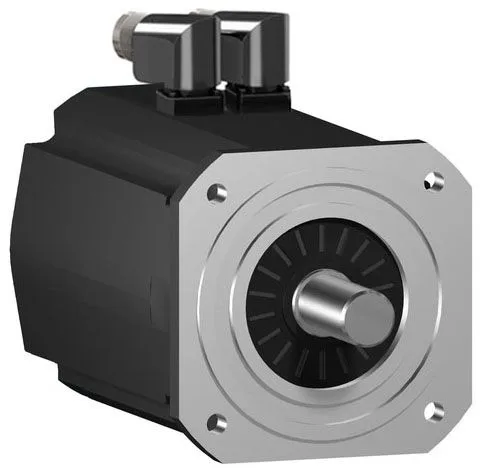
The SH32053P11F2200: This SH3-series servo motor delivers 10.6 kW continuous at 400 V three-phase, with nominal torque of 50.7 Nm. On 480 V three-phase it produces 10.1 kW and 40.2 Nm. Single-phase 115 V and 230 V inputs yield lower output — 4.45 kW / 84.9 Nm and 7.79 kW / 74.4 Nm respectively — so the supply voltage directly sets the usable torque in the application. Nominal speed varies by supply: 500 rpm at 115 V single-phase, 1000 rpm at 230 V single-phase, 2000 rpm at 400 V three-phase, and 2400 rpm at 480 V three-phase. The 2400 rpm ceiling at 480 V makes this a medium-speed servo suited to direct-drive or low-ratio applications.
Torque capability and brake
The holding brake holds 80 Nm static — enough to keep the load from drifting when the drive is off. This is a spring-applied, electrically-released brake; it engages on power loss, so it serves as a safety-holding device for vertical-axis loads.
Shaft, flange, and environmental sealing
The 38 mm shaft with a 10 mm parallel key and 80 mm shaft length matches standard coupling bores for medium-frame servos. The international standard flange (205 mm pilot diameter, 14 mm mounting holes, 4 mm centring collar depth) bolts directly to common gearbox input flanges without an adapter plate. IP65 on the motor body and shaft bushing, plus IP67 on the housing — this motor handles washdown environments and dusty conditions. The rotatable right-angled connector lets the cable exit in any quadrant, simplifying routing in tight cabinets or on moving axes.
Encoder feedback and electrical limits
The absolute single-turn SinCos Hiperface encoder provides position feedback without a home cycle on power-up — the drive reads the absolute position from the encoder's multi-turn count. This eliminates the need for reference marks on the machine frame and speeds commissioning. Stator resistance is 0.2 Ω and inductance is 2.05 mH, giving a low electrical time constant for good current-loop response. Maximum RMS current is 136.1 A, which sets the drive sizing requirement — the servo drive must supply at least this peak current for 3 seconds to use the full stall torque. Back EMF constant is 172 V/krpm at 20°C — at 2400 rpm the motor generates 413 V back EMF, so the drive DC bus must stay above this to maintain current control. The torque constant is 2.84 Nm/A at 120°C copper temperature, giving a linear torque-to-current relationship for the servo loop.
Mechanical load limits
Maximum radial force at the shaft nose is 4500 N at 1000 rpm, dropping to 3570 N at 2000 rpm and 3120 N at 3000 rpm. Maximum axial force is 740 N. These limits govern belt-drive or overhung-load applications — exceeding them shortens bearing life. Cooling is by natural convection — no external fan or forced air required. The motor relies on its surface area and the mounting flange for heat dissipation, so it must be mounted on a metal surface or have free air circulation around the housing.