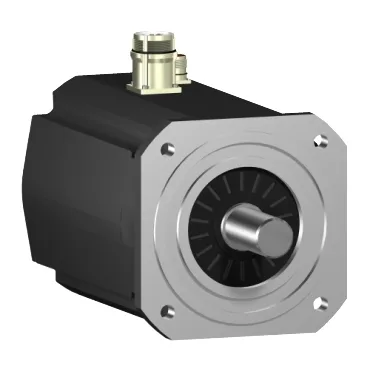
SH3 servo, 205 mm flange — what lands on the bench
The SH32053P12A1200: Electrical connection is a straight connector, and the sealing stack is the real deployment story: IP65 on the motor body, IP65 on the shaft bushing, IP67 on the housing — each to IEC 60034-5 — so the motor body tolerates jet wash while the shaft seal is rated to that same level and the housing takes immersion. Cooling is natural convection, with no integrated fan, so the cabinet or machine surface area around the housing sets the thermal headroom.
Three-phase performance envelope, 115 to 480 V
The headline rating is 10.6 kW continuous power, delivered at 400 V three-phase at 2000 rpm with 50.7 N·m nominal torque. The same frame runs across the full industrial voltage range — 4450 W at 115 V single-phase, 7790 W at 230 V single-phase, 10620 W at 400 V three-phase, 10100 W at 480 V three-phase — so the same order code covers light single-phase duty up to factory-floor three-phase output. Torque constant is 2.84 N·m/A at the 120 °C copper-hot benchmark, and the back-EMF constant is 172 V/krpm at 20 °C — these two numbers scale together, and they set the drive sizing for any given bus voltage. Stator resistance is 0.2 Ohm with 2.05 mH inductance; the maximum RMS current is 136.1 A and the 3-second peak output current is the same 136.1 A, so the drive current limit and the motor thermal ceiling already line up at this frame size. Peak stall torque is 330 N·m and continuous stall torque is 94.4 N·m, both across the full 115–480 V window. The peak figure is what defines a short-cycle acceleration capability; the continuous stall number is the one that governs a held-load application, and it is roughly one-third of the peak — oversizing the drive for the peak is normal, but a process that holds torque at standstill should be sized to the continuous figure instead.
Mechanical load ceiling and feedback stack
Radial load capacity falls off with speed: 4500 N at 1000 rpm, 3570 N at 2000 rpm, 3120 N at 3000 rpm. Axial load is capped at 740 N. With a 38 mm shaft and a 10 mm parallel key, the frame is built for direct-coupled gear or pinion loads at moderate speeds rather than belt drives at high rpm — the radial derating above 2000 rpm is the spec line to watch on any belt or pulley coupling. Feedback is an absolute multiturn SinCos encoder on the Hiperface protocol. That is the protocol pair to check against the drive side before commissioning — a Hiperface SinCos multiturn absolute encoder talks to a Lexium-series or compatible Schneider drive, and the drive selection determines whether position retention on power-cycle comes through the encoder battery path or the drive-side memory.
Lifecycle posture and sourcing channel
The lead-time and price-break ladder come back with the quote, not from the catalog page.