Headline rating and what 10.6 kW continuous actually buys
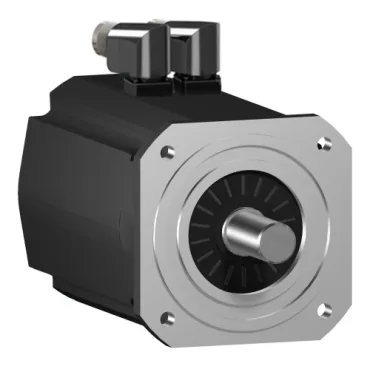
The SH32053P12A2000 is a three-phase servo motor from the Schneider SH3 line, rated for 10600 W of continuous mechanical output on its 400 V three-phase operating point and 4450 W to 10620 W across the full 115 V single-phase to 480 V three-phase range, which is the figure that sizes the drive and the cabinet supply breaker rather than the headline peak number. The sizing reference SH32053P12A2000P and 205 mm international-standard flange tell the panel builder this is a mid-frame SH3, not a compact or a high-inertia variant. Continuous stall torque is 835.5 lbf.in (94.4 N.m) across the 115 V to 480 V range, with a peak stall capability of 2920.7 lbf.in (330 N.m) and 136.1 A peak Irms for the 3-second overload window the drive uses to accelerate inert loads and clear stalls. Nominal torque drops with operating voltage — 84.9 N.m at 115 V single-phase down to 40.2 N.m at 480 V three-phase — so the application torque profile has to be matched to the bus the cabinet actually feeds. The 38 mm shaft, 80 mm shaft length and parallel-key shaft end are sized for the kind of coupling and gearbox stack a 10.6 kW continuous servo normally drives — large conveyors, web-handling lines, machine tool spindles and packaging form-fill-seal axes. Natural-convection cooling keeps the thermal envelope to 266 °F (130 °C) copper hot, which means the cabinet still needs airflow headroom; this is not a sealed-force-ventilated machine.
Feedback, connections and the encoder decision
Feedback is an Absolute multiturn SinCos Hiperface encoder — the resolver-free SinCos tracks give the drive the high-resolution position loop expected on a 10.6 kW axis, and the multiturn absolute output means the controller retains machine position through power cycles without a homing routine. The electrical connection is specified either as a straight connector or a rotatable right-angled connector, which lets the panel builder land the cable in the cable tray orientation the cabinet actually allows without forcing a service loop. No holding brake is fitted on this build of the SH32053P12A2000 — the zero brake inertia confirms a brake-less rotor, so vertical-axis applications where the motor must hold position with power removed need either an external brake on the gearbox or a different order code from the SH3 family that carries the brake option.
Shaft loading, mechanical envelope and sealing
Shaft loading is governed by the published radial-force curve: 4500 N at 1000 rpm, 3570 N at 2000 rpm and 3120 N at 3000 rpm, so a belt or pinion drive on the shaft has to be sized against the operating speed rather than the headline peak torque. Maximum axial force is 740 N, which covers most helical-bevel and worm gearbox stacks but is the limit to check when the application is a long leadscrew with thrust load. Mechanical envelope is 19.3 in (489 mm) overall length on a 205 mm flange with a 180 mm centring collar, 14 mm mounting holes and a 4 mm centring-collar depth — a standard IEC mounting footprint that drops onto the machine bed without adapter plates. The shaft seal package is IP54 at the shaft bushing without a seal ring, IP65 at the shaft bushing and IP65 at the motor body per IEC 60034-5, so the standard build handles dust and washdown splash typical of packaging lines but is not a full IP67 food-grade configuration.
Lifecycle and the buying decision
With no official successor or cross-reference order code published alongside it, the procurement decision rests on confirming the bus voltage, encoder protocol and brake/no-brake build against the BOM rather than chasing a substitute — the Hiperface feedback and the 205 mm flange are the keys to matching a second source within the SH3 family. Volume supply for the SH32053P12A2000 is quoted against the BOM through independent distribution; lead time and price-break ladder are confirmed at RFQ. Single-unit packaging is standard, so panel builders ordering a multi-axis line receive each motor as one shippable unit rather than as a kit.