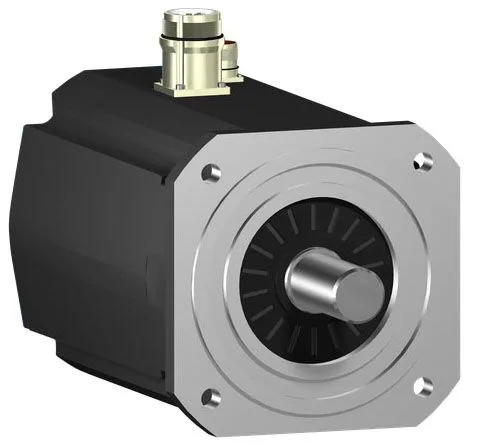
Frame, feedback, and what this motor is built to drive
The SH32053P12F1100 is a SH3-series servo motor on the 205 mm SH32053P frame, with an absolute multiturn SinCos Hiperface encoder on the rear and a rotatable right-angled or straight connector for the power and feedback cable (cites:,). It is a five-pole servo motor in the natural-convection-cooled class, sealed to IP65 on the motor body and shaft bushing per IEC 60034-5, which means it tolerates hose-down and dusty industrial atmospheres without a separate blower (cites:,). Mounting is an international-standard flange with 14 mm mounting holes, a 38 mm diameter shaft, 80 mm shaft length, and 10 mm parallel key — sized for the typical servo gearbox and coupling stack found on conveyors, mixers, and pump-station actuators (cites:,).
Voltage-dependent torque and power — drive sizing reads the whole table
Holding torque is 80 N.m (708.06 lbf.in), but the continuous nominal torque shifts with the supply the drive delivers: 84.9 N.m at 115 V single phase, 74.4 N.m at 230 V single phase, 50.7 N.m at 400 V three phase, and 40.2 N.m at 480 V three phase — the drop between 115 V and 480 V operation is the bigger selection knob than the headline figure (cites:,). Nominal output power tracks the same curve, from 4450 W at 115 V single phase up to 10620 W at 400 V three phase, then back down to 10100 W at 480 V three phase — operating at 400 V three phase is the sweet spot for torque-per-amp before the iron losses take over at 480 V (cites:). Continuous power is rated 10600 W, and nominal speed rises from 500 rpm at 115 V single phase to 2400 rpm at 480 V three phase — so the rated mechanical output shaft speed depends on what the drive is set to, not on a single nameplate number (cites:,).
Peak torque, shaft loading, and what the axis will actually see
Continuous stall torque is 94.4 N.m (835.5 lbf.in) from 115 V through 480 V three phase, and peak stall torque reaches 330 N.m (2920.7 lbf.in) at 115...480 V three phase — the 3.5× headroom between continuous and peak is what lets the axis punch through acceleration transients without tripping the drive (cites:,). Maximum radial load on the shaft is 4500 N at 1000 rpm, 3570 N at 2000 rpm, and 3120 N at 3000 rpm; maximum axial force is 740 N. Run the gearbox or coupling close to the motor face — the shaft drops load capacity fast once you go past about 1000 rpm (cites:,).
Drive commissioning constants and thermal envelope
Back-EMF constant is 172 V/krpm at 20 °C and torque constant is 2.84 N.m/A at 120 °C, so the drive's current loop has a clean scaling factor from commanded current to shaft torque once the thermal derating is applied at the copper hotspot temperature of 130 °C (cites:,). Stator resistance is 0.2 Ohm and stator inductance 2.05 mH, with maximum current Irms and 3-second peak output current both listed at 136.1 A — the current-loop tuning is set by the L/R ratio, and the peak value is the ceiling the drive enforces during the S-curve accel phase (cites:,). Centring collar depth is 4 mm and the encoder is the absolute multiturn SinCos Hiperface type — meaning position is retained through power cycles, and the drive recognises the motor electronically on first power-up without a homing sequence (cites:,).
Lifecycle and how it lands on a procurement desk
Lifecycle stage on this MPN is listed as current, so it is being specified against new builds today; the SH3 family sits in the medium-inertia, natural-convection class used where the cabinet has no forced-air budget but the axis still needs clean torque at low speed (cites:,). Pricing and current availability are confirmed at quote time and quoted against the BOM quantity (cites:).