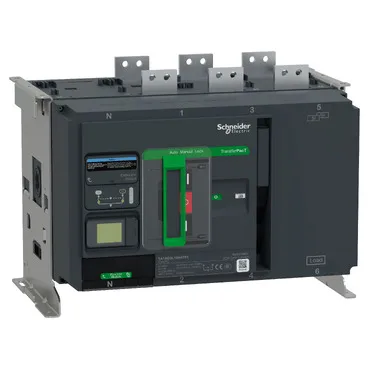
The Schneider Electric TA1AD3L10H4TPE is a TransferPacT automatic transfer switch (ATS) rated for 1000 A continuous at 400 V AC, 50/60 Hz. That 1000 A is the conventional free-air thermal current (Ith) at 60 °C — meaning the switch carries that load indefinitely without derating in a typical enclosed panel at that ambient. The utilization category is AC-33B, which covers mixed motor and resistive loads with high inrush: pumps, compressors, lighting banks, and general building services where the switch sees both steady-state and transient starting currents. This is not a residential transfer switch; it is sized for a 1000 A service entrance or a critical-load feeder in a commercial or industrial facility. The switch is rated for 50 kA short-time withstand (Icw) for 0.5 s and 70 kA for 0.1 s, with a making capacity (Icm) of 105 kA as a stand-alone switch-disconnector, or 154 kA with an upstream circuit breaker. That tells you the fault energy this thing can survive without welding its contacts — critical for coordination studies. The PC class (per IEC 60947-6-1) means it is designed for full-rated switching, not just isolation; it makes and breaks load current, not just transfers a dead bus.
Integration and mounting constraints
Mounting is fixed plate — no DIN-rail clip. The envelope is 540 mm wide by 391 mm high by 383.5 mm deep, with a connection pitch of 115 mm. That is a substantial footprint; plan for a dedicated sub-panel or backplate in the enclosure. Both upside and downside connections are screwed terminals, so expect lug-type terminations for the 1000 A cable or busbar. The front face is IP40 in auto mode; the interior (manual mode) is IP20 — the switch is not rated for washdown environments, but the IP40 front is fine for a typical indoor switchboard.
What the standards and approvals cover
The switch is designed and tested to IEC 60947-6-1, the standard for automatic transfer switches. The rated insulation voltage (Ui) is 1000 V for the switch and 500 V for the controller; impulse withstand (Uimp) is 12 kV for the switch and 6 kV for the controller. Mechanical interlocking prevents both sources from closing simultaneously. The LCD screen on the controller provides status and parameter visibility without opening the enclosure door.