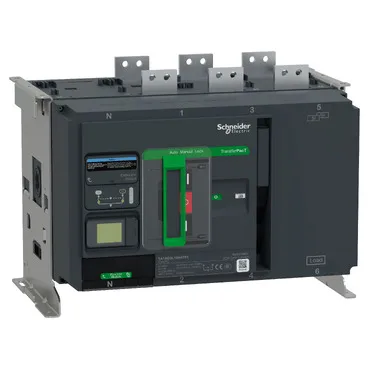
The TA1AD3L16H4TPE is a Schneider Electric TransferPacT automatic transfer switch (ATS) — a PC-class changeover device rated for uninterrupted duty that automatically shifts a critical load between two sources of supply when one fails. It's built to the IEC 60947-6-1 standard for transfer-switch equipment, which covers everything from the mechanical interlock to the short-circuit making and breaking performance. Rated 1600 A at 400 V AC, 50/60 Hz, in utilization category AC-33B — that's the heavy lifting category for mixed motor, resistive, and lightly inductive loads with high inrush, typical of industrial feeders, pump stations, and HVAC risers. The 1600 A figure is the operational current (Ie) and also the conventional free-air thermal current (Ith) at 60 °C, so it's not a derated number; you get the full 1600 A in a 60 °C enclosure.
Short-circuit muscle and isolation
Short-time withstand (Icw) is 50 kA for 0.5 s, or 70 kA for 0.1 s — that's the fault energy the switch can ride through without welding or blowing apart. Making capacity (Icm) is 105 kA as a standalone switch-disconnector, and jumps to 154 kA when paired with an upstream circuit breaker. The switch is also rated for isolation (suitability for isolation: yes), with a visible contact-position indicator and a padlockable OFF position. Insulation coordination: rated impulse withstand voltage (Uimp) is 12 kV across the switch, 6 kV on the controller. Pollution degree 3 means it's designed for the conductive-dust and condensation environment of an industrial panel — not a clean-room toy.
Footprint is 540 mm wide × 391 mm high × 383.5 mm deep, with a 115 mm connection pitch between phases. Mounting is plate-fixed (not DIN-rail), so you'll need to drill and tap the backplate or weld on a mounting bracket. Both upside and downside connections are screwed — expect to torque M12 or similar hardware on a 1600 A bus. Front-face protection is IP40 in auto mode, which keeps tools and fingers out; inside the enclosure the manual-mode area drops to IP20. The LCD screen shows source status and operating mode (auto or manual). Signal contacts are configurable as 1 NO + 2 NC, 1 NC + 2 NO, or 2 NO — enough to feed a BMS or PLC with source-available and position feedback.