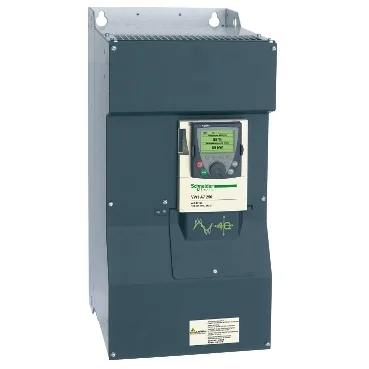
What this AIC does and where it fits
The VW3A7278: Continuous output current is 765 A across the full voltage range (500 V, 600 V, 690 V). The overload capability is 1.20× nominal for 60 seconds or 1.35× for 2 seconds — useful for sizing upstream protection and cabling. Built-in unit with IP00 protection — no enclosure, so it's designed for integration into a cabinet or panel with forced convection cooling. The cooling air volume is 2400 m³/h for the power circuit and 400 m³/h for the control circuit, and the required air flow surface is 2000 cm². Thermal losses are 11,980 W — that heat has to be managed in the enclosure design.
Lifecycle reality — obsolete, sourced to order
Schneider lists this AIC as obsolete (mature lifecycle stage). For a line-down spare or a BOM fill, the part is available through independent distribution channels — quantities are confirmed at RFQ, not held in stock. Because it's obsolete, the procurement path is surplus or broker sourcing. No last-time-buy window remains open. The page posture is quoted-to-order: submit an RFQ for the quantity you need, and availability plus current pricing come back at quote time.
Physical footprint and integration constraints
Dimensions are 1110 mm wide × 1390 mm high × 377 mm deep — a large cabinet-mount unit. The operating position is vertical within ±10 degrees. Vibration resistance is 1.5 mm at 3–10 Hz and 0.6 gn at 10–200 Hz per EN/IEC 60068-2-6; shock resistance is 4 gn for 11 ms per EN/IEC 60721-3-3. Ambient operating temperature range is -10 to 45 °C, with derating above 45 °C (2 % per °C up to 60 °C). Storage range is -25 to 70 °C. Pollution degree 2 per EN 61800-5-1, and environmental classification is 3K3/3C2/3S2 per EN/IEC 60721-3-3.
Communications and compliance
Communication is via a built-in bridge with one RJ45 for Modbus and one male SUB-D 9 on RJ45 for CANopen. The supported protocols are CANopen and Modbus. The option card is listed as a communication bridge. Compliance documentation covers EN/IEC 61800-5-1 (adjustable speed electrical power drive systems). The unit is designed for low-harmonic operation and energy regeneration — it's the front end for systems that need to meet grid harmonic limits and recover braking energy.