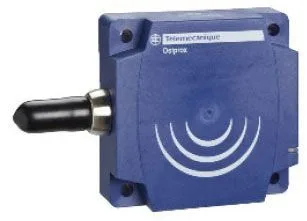
The Telemecanique XS7D1A1PBM12 is a size-D block-style inductive proximity sensor in the XS7 family, built in a PBT housing at 80 mm W x 26 mm D x 80 mm H and rated to NEMA 1/4X/12 and IP67. It runs on 12 to 24 VDC, switches a PNP normally-closed output on three wires through a 4-pin micro M12 connector, and indicates state through an on-body LED. Square D / Telemecanique holds the brand; UL, CSA, and CE are the approvals carried on the nameplate.
What the key ratings decide
Sensing distance of 40 mm is the headline reach — long enough for door-state, end-of-stroke, and pallet-presence work on conveyor frames where the target cannot sit flush against the face. The 100 Hz switching frequency is the matching ceiling, so it is suited to static-position detection and slow-rev applications rather than high-count rack-and-pinion or encoder-replacement tasks; the LED on the body makes commissioning and fault isolation a one-person job. Output configuration is PNP normally-closed, 3-wire on a 4-pin micro M12 connector — that matches standard PNP sensor inputs on common PLCs and drive I/O without re-anything on the wiring side. Maximum load current is 100 mA, which is the channel-level ceiling when paralleling outputs; it is not a per-pin figure. Operating voltage spans 12 to 24 VDC and operating temperature spans -13 to 158 deg F, so the sensor tolerates cold-storage cabinets and most warm enclosures near a drive without derating. The IP67 enclosure handles panel-side splash and incidental wash, but the housing is PBT, not stainless, and there is no IP69K rating on this record — for daily high-pressure hot caustic on a dairy line, a stainless IP69K body is the more honest choice.
The Telemecanique XS7C1A1PAL01M12 sits in the same family at size C — 40 mm W x 15 mm D x 40 mm H, with a 15 mm sensing range and a 1000 Hz switching frequency on a PNP normally-open output through a 0.1 m pigtail to a 4-pin micro M12 connector. The functional trade-off is reach versus speed and form factor: this seed covers more air-gap but cycles slower, while the size-C body fits tighter mounting with faster response. Output logic also flips — NC here versus NO on the size-C part — so a drop-in swap would require confirming that the downstream input accepts NC at 100 Hz before re-wiring.