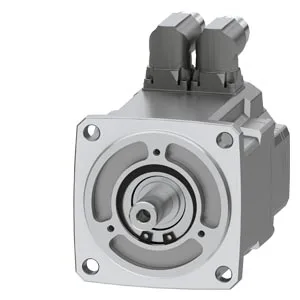
What this motor is and why it matters on a line
1FT2205-4AZ10-0RB0-Z K1B+P90+Q01 is a SIMOTICS S-1FT2 CT synchronous servo motor from the SIMOTICS S family of compact, high-dynamics servomotors used in machine-tool and motion-control axes. The CT (Combi Torque) variant pairs a low-inertia rotor with an integrated holding brake so the axis holds position when the drive enable is removed — a standard fit on vertical axes, tool changers, and any load that must not sag on power loss. At 4500 r/min that 1.74 kW ceiling sets the upper bound for continuous duty — sizing the SINAMICS drive S120 or S210 to the same shaft rating is the engineering handshake; over-rating the drive won't push the motor past its thermal limit, but under-rating it will trip I²t on acceleration ramps.
Feedback, brake, and the connectors on the back of the housing
Feedback is a resolver (2-pole) plus an integrated Pt1000 temperature sensor in the winding, both routed to a single M17 signal connector. The Pt1000 lets the drive model the rotor temperature in real time rather than trusting an I²t estimate — meaningful on cyclic S-curves where the winding thermal time constant is shorter than the resolver update cycle, and where an unplanned thermal cutback kills a production run. The power side terminates on a separate M17 power connector, and the variant carries an integrated holding brake. One signal connector plus one power connector is the standard S-1FT2 wiring pattern — the motor cable assemblies are matched M17 cordset sets rated for the encoder and power pair, not generic M23 leads.
Sourcing posture for a built-to-order servo motor
Lifecycle stage on the Siemens ordering data is listed as current, and the product class is C — built-to-order, not returnable for credit. For a procurement team that means lead time is factory-driven, not shelf-driven: order quantity 1 Piece, confirmed at RFQ against the build slot, with packaging in the standard 1-piece carton unless the K1B+P90 option triggers the bulk-pack 28-unit configuration noted in the description string. REACH is reported as information-on-request rather than as a clean declaration — a procurement or QA spec sheet that hard-requires the REACH candidate-list statement should be sent with the RFQ so the factory disclosure is captured at quote time.