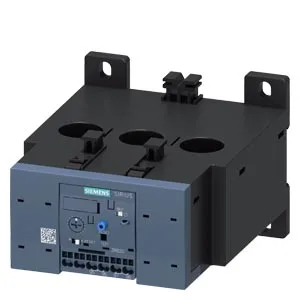
The 3RB2056-1FX2: Rated for 1,000 V AC-3e maximum and 50/60 Hz, it uses straight-through current transformers on the main circuit so there's no power loss across the sensing element — just a signal to the trip logic. The integrated auxiliary switch carries a note for message 'tripped', meaning the relay outputs a dedicated signal when it operates, not just a generic fault. This is useful for a PLC or HMI to log exactly which motor tripped on overload, rather than wiring a common alarm.
Mounts directly onto a contactor or as a standalone unit — any position works, which simplifies panel layout. The S6 footprint is 120 mm wide by 119 mm tall by 155 mm deep, so it needs a solid chunk of DIN rail or backplate real estate. Storage and transport handle -40 to +80 °C. Vibration resistance is 1-6 Hz at 15 mm amplitude and 6-500 Hz at 20 m/s² for 10 cycles; shock tested to 15g for 11 ms per IEC 60068-2-27. It'll survive the ride out to the job site and the shake of a contactor closing next to it. Wiring terminals accept 2x (0.25 to 1.5 mm²) solid or stranded — spring-cage or screw, depending on the variant. Strip length and ferrule sizing follow standard panel practice.
The integrated auxiliary switch has a range of voltage and current ratings: 2 A at 24 V, 0.55 A at 60 V, 0.3 A at 110 V, 4 A at 120 V, 0.3 A at 125 V, 0.11 A at 220 V, and 3 A at 230 V. These cover both DC control circuits and AC pilot duty — pick the column that matches your control voltage.
Motor power ranges
For AC motors at 500 V / 50 Hz, it covers 30 to 132 kW; at 690 V / 50 Hz, 55 to 160 kW. That's a wide band, so it fits a range of motor frame sizes without swapping the overload relay for a different model.