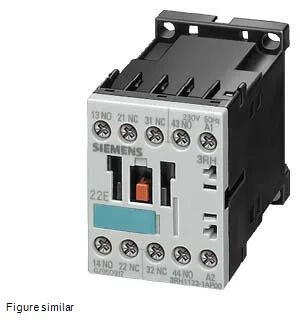
It's the part you grab when the control circuit needs extra signal paths — interlocking a starter, feeding a PLC input, or extending an existing contactor's auxiliary capacity without swapping the main block.
Terminals accept solid conductors: 2x 0.5 to 1.5 mm², 2x 0.75 to 2.5 mm², or 2x 4 mm². That covers the common control-wire gauges — 1.5 mm² for most signal runs, 2.5 mm² for longer loops, and 4 mm² if you're paralleling feeds.
RoHS compliance date is July 1, 2006, so it meets the original EU RoHS directive.
Switching capacity across voltages
The contact ratings drop as voltage climbs: 10 A at 24 V, 6 A at 230 V, 3 A at 400 V, 2 A at 500 V, and 1 A at 690 V. That's the standard derating curve for an auxiliary contactor — the arc energy at higher voltages limits the current the contacts can break reliably. For a 400 V control circuit, plan on 3 A per contact.