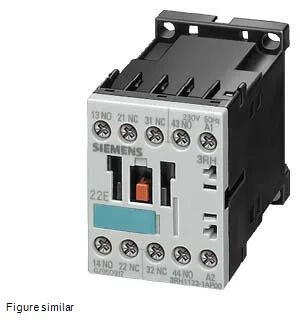
It's the switching element for control circuits — pilot lights, PLC inputs, contactor coils, relay loads — not a main power contactor.
The headline rating is 10 A at AC-12 (resistive loads at 24 V). That is the maximum continuous current through each contact when switching resistive loads like indicator lamps or solenoid valves. For inductive loads — contactor coils, small relays — the rating drops: at 230 V it is 6 A, at 400 V it is 3 A, at 690 V it is 1 A. The AC-12 figure governs the control-circuit bus; the derated numbers govern what you can actually switch on a 400 V line. The 6 kV rated surge voltage means the contacts handle the transients from switching inductive loads without welding shut — standard for a 400 V industrial panel.
The 45 mm width occupies a single DIN-rail slot, so it fits in crowded panel layouts. Wiring accepts solid conductors from 0.5 mm² up to 4 mm² (or 2x 1.5 mm², 2x 2.5 mm²) and AWG equivalents.
Mechanical endurance
Rated for 30 million mechanical operations typical. That is the life of the contact carrier and spring mechanism before wear-out — not the electrical life, which depends on load current and switching frequency. For a control-circuit contactor that cycles once per machine cycle, 30 million operations translates to roughly a decade of continuous three-shift operation.