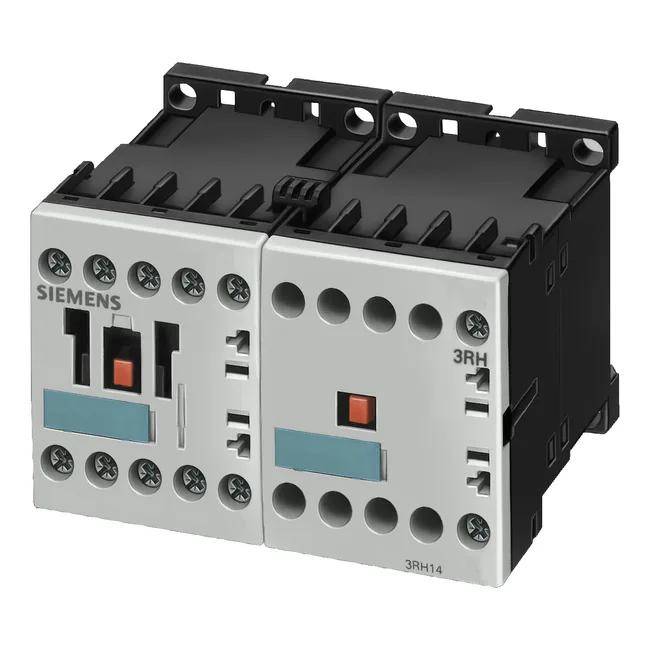
SIRIUS auxiliary contactor for signal feedback and control logic
It carries 2 normally open instantaneous contacts rated at 10 A for AC-12 duty at 24 V, meaning it handles resistive control loads like PLC inputs, relay coils, and indicator lamps up to that current. The AC-12 rating is the key figure for control-circuit switching — it defines the make-and-break capability for resistive loads, not motor inrush. Mounting is via screw or snap-on onto a DIN rail, with the size S00 footprint (57.5 mm high, 90 mm wide, 72 mm deep) fitting standard panel layouts. Wire capacity covers solid and stranded conductors: 2x 0.5…1.5 mm², 2x 0.75…2.5 mm², or 2x 4 mm² per terminal. That range handles most control-circuit wiring from signal-level through power-limited circuits.
Switching capacity across control voltages
The contact ratings drop with voltage as expected for a DC-13 / AC-15 auxiliary contact block. At 24 V it switches 10 A (AC-12); at 110 V the rated current is 1 A; at 230 V it's 6 A; at 400 V it's 3 A; and at 690 V it's 1 A. These are the maximum break currents at each voltage level — for a given application, match the load's inrush and steady-state current to the appropriate voltage row.
Panel integration and environmental limits
Clearance: zero mm required at the side for air circulation. Shock resistance is 10g for 5 ms and 5g for 10 ms, adequate for most industrial machinery but not for extreme shock applications like forging presses without additional isolation.