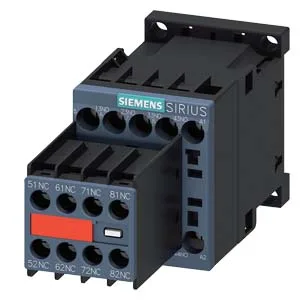
It is the switching element that follows the main contactor or relay in a control circuit — used to pick up status feedback, interlock sequences, or drive pilot loads. The 10 A rating at 24 V covers most PLC output and indicator circuits; at 230 V the contacts are rated for 6 A, and at 400 V for 3 A, so the same block handles mixed-voltage control panels without derating surprises.
Depth of 117 mm is the dimension from DIN rail face to the front of the terminals; plan for finger-safe cover clearance.
Contact ratings across voltages
The four contacts are rated for switching at multiple voltage levels — a single block covers control voltages from 24 V up to 690 V. At 24 V the contacts carry 10 A; at 60 V, 4.7 A; at 110 V, 3 A; at 220 V, 1.2 A; at 230 V, 6 A; at 400 V, 3 A; at 440 V, 0.5 A; at 500 V, 2 A; at 600 V, 0.26 A; and at 690 V, 1 A. The arcing time is 10 to 15 ms at AC and 4 to 15 ms at DC, with a mechanical life of 10 million operations. These are the numbers that govern whether the contactor holds up in a given circuit — the 24 V and 230 V figures are the ones most buyers will check first for control transformer or PLC output duty.
The substance prohibitance date of 10/01/2009 aligns with RoHS compliance — the part meets the EU RoHS exemption framework in effect from that date.