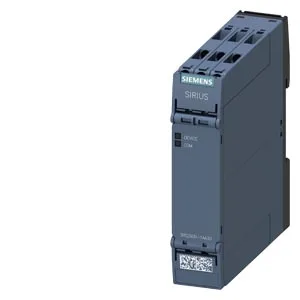
The Siemens 3RS2900-1AW30 is a SIRIUS temperature monitoring relay — a sensor extension module designed to accept up to two additional resistivity sensors (like Pt100 RTDs) plus a 4-20 mA analog input, then drive a status relay based on the programmed thresholds.
The status relay contacts are rated 1 A at 24 V DC, 0.2 A at 125 V DC, and 0.1 A at 250 V DC — these are the maximum switching currents at those voltages, not continuous carry. If you're driving a contactor coil or a small solenoid, verify the inrush doesn't exceed these DC limits; for AC loads, the relay is switching the same 24-240 V range it's powered from. The relative metering precision is 1 % of full scale, with a full-scale value of 1.1 and an initial value of 0.85. That means it belongs inside a control cabinet, not on the machine frame exposed to washdown or coolant mist. Mounting position is any, which helps when panel layout is tight.
The switching behavior is monostable — the relay drops out when the monitored temperature returns below the threshold. An error memory is available (settable), and an external reset input is present, so you can latch the alarm until manually acknowledged if the application demands it. Terminals accept solid wire 20-12 AWG (1x) or 20-14 AWG (2x), and stranded 20-12 AWG. Isolation between input and output is provided, which is critical when the sensor loop shares a cabinet with motor drives or switching power supplies — it prevents ground loops from coupling noise into the measurement.
Environmental limits
The 60 °C upper operating limit is fine for most ventilated cabinets; if the panel sits near a heat source (drive heatsink, transformer), check the internal ambient doesn't exceed that. Clearance requirements are zero in all directions (upwards, downwards, forwards, backwards, at the side) — meaning it can be mounted flush against adjacent devices without derating, which simplifies high-density panel layouts.