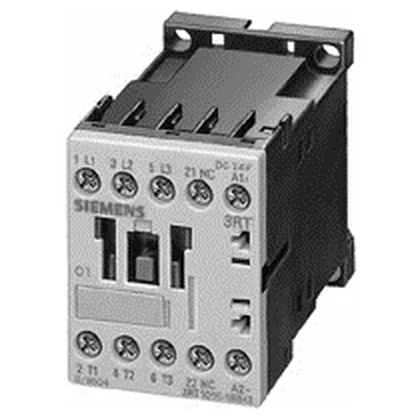
The Siemens 3RT1017-1AG61 is a SIRIUS power contactor in the compact S00 frame — 45 mm wide, 57.5 mm tall, 72 mm deep — built to switch motor loads in control panels and machinery. Rated for 5.5 kW at 400 V in AC-2 duty (slip-ring motor starting) and 8.5 A in AC-4 duty (plugging/inching), this contactor handles the heavy switching cycles that wear out a general-purpose relay fast. Mechanical endurance is listed at 30 million operations — that's the theoretical life of the mechanism before wear-out, not the electrical life under load.
Coordination and protection — what the fuse ratings tell you
The evidence lists two coordination types: Type 2 coordination requires a 20 A gL/gG fuse upstream; Type 1 coordination allows a 35 A gL/gG fuse. Type 2 means the contactor survives a short-circuit fault without damage — no welding, no replacement needed — which matters on a line where downtime costs more than the fuse. Type 1 accepts that the contactor may be damaged and need swapping after a fault, but lets you use a higher-rated fuse for better selectivity with downstream devices. If you're specifying for a new panel, Type 2 with the 20 A fuse is the safer bet for uptime. If you're retrofitting into an existing distribution board with a 35 A backup fuse already in place, the contactor accepts that — just plan for a possible swap after a bolted fault.
Auxiliary contact ratings — what the small numbers mean for control circuits
The built-in auxiliary contacts are rated for 10 A at 24 V, 6 A at 230 V, and 0.3 A at 220 V DC. That DC rating is the one that catches people — at 220 V DC the contact can only break 0.3 A, so if you're switching a DC coil or a DC-powered indicator lamp at that voltage, verify the load current stays under that limit or add an interposing relay. At 24 V DC the contact handles 2 A, which covers most PLC output cards and small relays.
IP20 on the front and at the terminals — that's finger-safe but not washdown-rated. The contactor belongs inside a locked enclosure, not on the factory floor exposed to coolant mist or dust. Side-by-side mounting is allowed — no derating required for zero-gap stacking — so you can pack multiple contactors on a DIN rail without spreading them out for cooling.