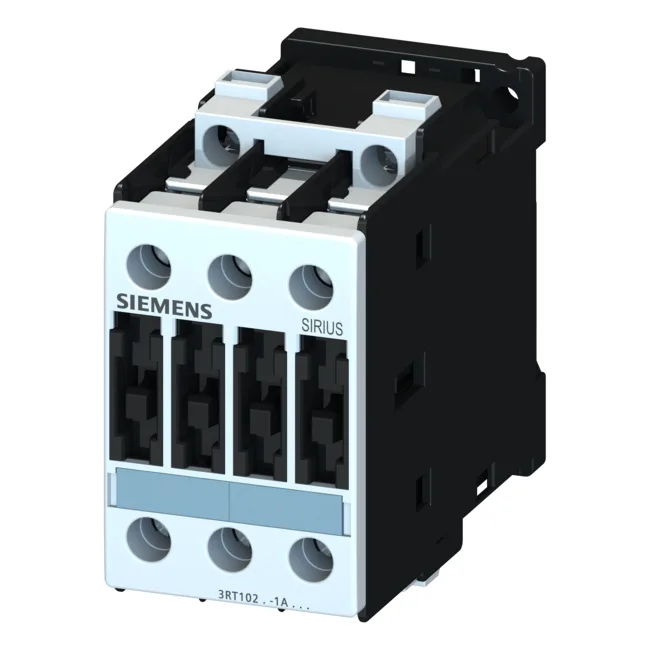
It's rated 11 kW at 400 V in AC-2 duty (slip-ring motors) and carries 15.5 A at 400 V in AC-4 duty (reversing or inching). For resistive loads, the AC-12 maximum operating current is 10 A. The coil is wound for 100 V at 50 Hz and 100–110 V at 60 Hz, with an operating voltage range of 0.8–1.1 times rated at 50 Hz and 0.85–1.1 at 60 Hz. That's a tight tolerance — if your control transformer sags under load, you'll want to confirm it stays above 80 V at 50 Hz.
The main circuit uses screw-type terminals accepting solid conductors up to 2x 4 mm² and stranded up to 2x 10 mm² (or 1x 8 AWG). That's enough for the motor leads on an 11 kW load at 400 V. The front of the contactor carries an IP20 rating — safe for finger-probe access in an enclosure. The terminal area is IP00, meaning the live parts are exposed if the panel door is open; standard practice is to mount it inside a locked cabinet or behind a cover. Pollution degree 3 (conductive or dry non-conductive pollution) is assumed, which is typical for industrial control rooms.
This is the spec the panel builder needs to match to the motor starter. Mechanical endurance is typical 10 million switching cycles. That's a long life for a motor contactor in cyclic duty — the limiting factor will be electrical wear under AC-4 inching, not the mechanism.