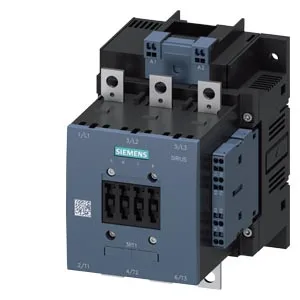
It carries a rated control supply voltage of 500...550 V AC at 50/60 Hz, with a pull-in power factor of 0.8 at both frequencies — meaning the inrush on the coil circuit is predictable across line supplies. This matters when you're fitting it into a tight panel layout where the busbar or gland plate forces an orientation change. The coil connects through spring-type terminals (push-in style), while the main power circuit accepts stranded cable from 25 to 120 mm² — a wide range that covers most motor feeds up to the S6 frame limit. Auxiliary wiring uses a separate spring terminal accepting 2x 0.25...2.5 mm² solid or stranded.
Ratings that drive the selection
Switching frequency varies by duty class: 800 operations per hour under AC-1 (resistive loads), 1,000 ops/h under AC-3 (standard squirrel-cage motor starting), and 130 ops/h under AC-4 (plugging/inching). The AC-3e rating matches the AC-3 figure at 1,000 ops/h — so if you're running a European motor with IEC efficiency class, the contactor handles the same cycle rate. The contactor includes an auxiliary switch, rated at 10 A at 24 V DC, 2 A at 48 V and 60 V DC, and 1 A at 110 V DC — useful for feeding a PLC input or a status lamp on the panel door. The contactor dimensions are 172 mm high, 120 mm wide, 170 mm deep; clearance requirements are 10 mm upward, 10 mm downward, 20 mm forward, and 10 mm at the side for arc dissipation and airflow.