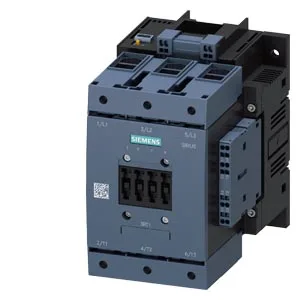
What this SIRIUS S6 contactor does in the panel
It mounts via screw fixing on a vertical surface, rotatable ±90° and tiltable ±22.5° front-to-back, giving panel builders flexibility in tight enclosures. The coil pulls in at 21–27.3 VDC (rated value range) and holds across that band, with a pick-up dropout ratio of 0.8 of initial value — meaning it drops out cleanly at about 16.8 V, preventing chatter on a sagging DC bus. Spring-type terminals on the magnet coil accept 2x (0.25–2.5 mm²) solid or stranded, while the main power circuit handles 16–70 mm² stranded cable — sized for the S6 frame's typical motor currents. The auxiliary switch is built in, with rated values of 10 A at 24 VDC, 2 A at 48 V, 2 A at 60 V, 1 A at 110 V, and 0.3 A at 220 VDC, covering pilot-duty and PLC input signaling needs.
Switching frequency and thermal limits
Maximum operating frequency varies by duty: 800 cycles/hour at AC-1 (resistive), 400 at AC-2, 1,000 at AC-3 and AC-3e (standard motor start), and 130 at AC-4 (plugging/inching). The AC-4 limit is the one to watch — frequent reversing or jogging will hit that ceiling fast. Arcing time runs 10–15 ms; operate time is 80–90 ms on both AC and DC coil supply.