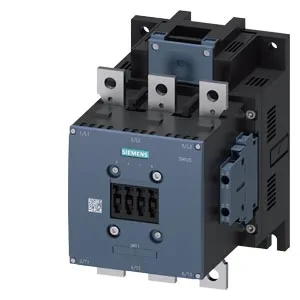
The physical envelope is 210 mm high, 145 mm wide, and 202 mm deep. That depth is the dimension you need to watch when the contactor sits behind a door or near a gland plate — 202 mm is not shallow, so verify your enclosure depth before committing the BOM line. Storage range is wider at -55 to +80 °C. The auxiliary contact block carries switching ratings that drop with voltage: 10 A at 24 V, 2 A at 48 V and 60 V, 1 A at 110 V, 0.9 A at 125 V, and 0.3 A at 220 V (-). At 230 V AC it's rated 6 A. These are the limits for your control-circuit loads — a PLC output or a small relay coil — not the main power path. The main power terminals accept stranded conductors from 70 to 240 mm². That's a heavy cable range — think 2/0 to 500 kcmil — which confirms this contactor is for the main motor feeder, not a control circuit. The auxiliary terminal capacity is smaller: 2x 0.5-1.5 mm² solid or 2x 0.75-2.5 mm² stranded, max 2x 0.75-4 mm².
It is an active catalog item, not a last-time-buy or NRND part. That said, for a frame S10 contactor with a specific coil voltage, you are not walking into a distributor stockroom and grabbing one off the shelf — this is a quoted-to-order line item. Submit an RFQ with your quantity and target delivery window.
Integration Note for the Wireman
These are the minimum air gaps for heat dissipation and arc containment. If you crowd the contactor against the enclosure wall or another device, you derate the thermal performance — keep the clearances. That's typical for a frame this size and informs your coordination study for upstream protection. That's a high-cycle rating — suitable for frequent start/stop applications like conveyors or pumps, not just infrequent isolation.