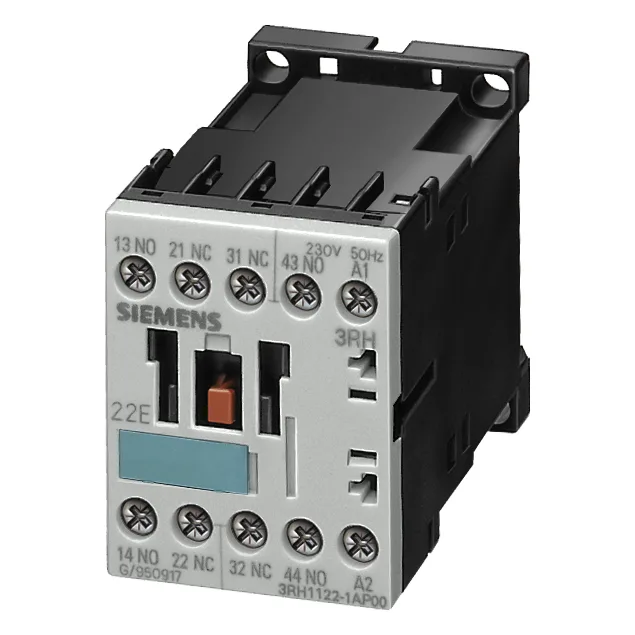
The 3RT1517-2BM40: The coil is rated for 220 V AC. That's the control voltage you need to supply from your PLC output or relay — pick-up is guaranteed at 85% of rated voltage (187 V) and it drops out at 1.1x (242 V), so it holds in through a saggy line but releases cleanly on a brownout. DC switching capability is where this contactor earns its keep in a control panel. At 24 V DC it's rated for 10 A; at 60 V DC, 2 A; at 110 V DC, 1 A; at 220 V DC, 0.3 A; at 400 V DC, 3 A; at 440 V DC, 0.8 A. These are the currents it can break without welding the contacts — the 400 V DC rating at 3 A is unusually high for a size S00 frame, so it handles DC motor braking or battery strings that would weld a smaller contactor. Auxiliary contacts are rated 12 A per NO and per NC — that's enough to drive a small contactor coil or a PLC input directly, no interposing relay needed. Main and auxiliary circuits rated impulse withstand voltage of 6 kV.
The 45 mm width means it occupies exactly one standard modular device slot — plan your rail layout accordingly. Side-by-side mounting is allowed with no derating gap, so you can pack a row of these without wasting panel space. That helps when the rail is in a tight corner or the panel door has a hinge constraint. IP20 on the front and terminals — finger-safe but not washdown.
Main circuit uses spring-loaded terminals — no screwdriver torque, no loosening over time from vibration. Accepts 2x (0.25 to 2.5 mm²) solid or stranded wire. Strip length and ferrule size matter: the spring cage needs a clean insertion, so use ferruled stranded for a reliable connection in a panel that gets shipped and shaken.
Mechanical endurance 30 million operations typical. At AC-1 duty maximum 1,000 switching cycles per hour. Maximum operating altitude 2,000 m without derating.