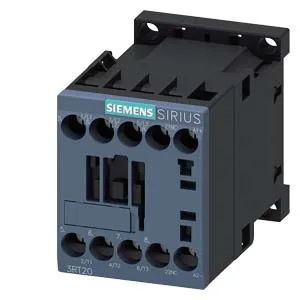
The main contacts are rated for 20 A (AC-1) through 12 A (AC-3) — the AC-3 figure is the one that governs motor switching; the AC-1 number applies for resistive loads like heaters. Switching frequency tops out at 750 cycles per hour for AC-3 duty, and 250 for AC-4 (plugging/reversing). If you're cycling a conveyor reverser faster than that, you'll need a larger frame or a dedicated reversing contactor pair. Coil pickup is at 0.8 x rated voltage, dropout at 1.1 x rated voltage. The coil uses screw-type terminals. Auxiliary contacts are present (one N.O. + one N.C. built in), rated for 10 A at 24 V, 2 A at 48/60 V, 1 A at 110 V, and 0.3 A at 220 V. That covers feedback to a PLC input or holding circuit on the coil. Wire range: solid or stranded 0.5 to 4 mm² (20 to 12 AWG), and it accepts two conductors per clamp in certain combinations (2x 0.5-1.5 mm², 2x 0.75-2.5 mm², or 2x 4 mm²). That's handy for daisy-chaining control power without extra terminals.
That's tight enough that you can stack contactors side-by-side on the same DIN rail without extra spacing, as long as you respect the 6 mm side gap. The arcing time is 10-15 ms, and DC dropout is 7-13 ms — fast enough for most interlocking circuits.