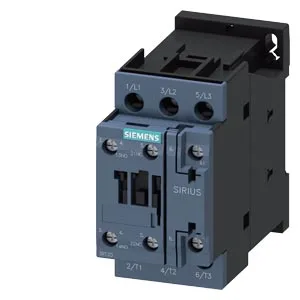
SIRIUS S0 power contactor — what fits and what doesn't
The S0 frame means it occupies 45 mm of DIN-rail width and stands 85 mm tall — a standard footprint that drops into most European-style panels without re-drilling gland plates. Rated for 1,000 operating cycles per hour under AC-1, AC-2, AC-3, and AC-3e duty, this contactor handles continuous switching of resistive and motor loads. The AC-4 rating drops to 300 cycles/h — that's the wear limit for plugging or inching duty, so if your application reverses the motor under load, expect shorter contact life at higher frequencies.
Mounting and wiring — DIN rail clearance
The standing position on a horizontal mounting surface is specified — don't lay it on its side without checking the manufacturer's derating curves. That 6 mm side gap is tight — adjacent devices on the same rail need that much breathing room for heat dissipation. For fine-stranded wire, the spec allows 2x (0.5 to 1.5 mm²) or 2x (0.75 to 2.5 mm²) — useful when paralleling control wiring. The coil connection uses screw-type terminals, so keep a PZ1 bit handy for termination.
Auxiliary contact ratings — what it switches on the control side
The built-in auxiliary switch is rated for 10 A at 24 V, 2 A at 48 V, 2 A at 60 V, 1 A at 110 V, 0.9 A at 125 V, 0.3 A at 220 V, and 0.6 A at 440 V. At 400 V it's rated 3 A. These are the make-and-break capacities for the auxiliary contacts — useful for PLC inputs, relay coils, or indicator lamps. The 230 V rating is given as 3 hp, which is the motor load the auxiliary can switch directly.
Coil and arcing characteristics
Coil holding current is 0.25 A at 50 Hz and 0.28 A at 60 Hz — the DC coil on this variant doesn't have a holding current spec listed, but the AC values give a sense of the inrush if you're sizing a control transformer for a mixed AC/DC panel. Arcing time is listed as 4 to 16 ms with a tighter 10 to 10 ms figure — the spread likely reflects load-dependent variation.