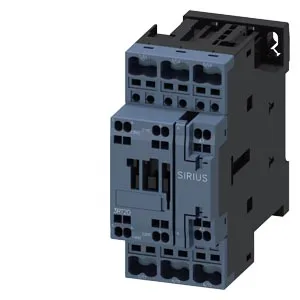
The main contact rating spans 18 to 8 A, covering small to mid-range motor circuits in a 45 mm wide package.
The 18-8 A main contact range tells you this contactor is sized for motors drawing up to about 8 A in AC-3 duty — think 3-4 kW at 400 V three-phase. The 24 VDC coil pulls 10 A through its auxiliary contacts at rated voltage, so the control circuit needs a 24 VDC supply capable of that inrush. Switching frequency tops out at 750 operations per hour in AC-3 and AC-3e, and 1000 in AC-1 resistive loads — enough for a conveyor or pump cycling every few seconds, but not for a high-speed pick-and-place. The spring terminals on the coil accept 1 to 10 mm² solid or stranded wire; main contacts take 2x (0.5 to 2.5 mm²) fine-stranded, so panel wiring is straightforward with standard ferrules.
The S0 frame is 45 mm wide, 102 mm tall, 97 mm deep, so it fits standard enclosure backplanes.
Switching performance and service life
Electrical life depends on duty: AC-1 (resistive) at 1000 ops/h, AC-2 and AC-3 (motor start/run) at 750 ops/h, AC-4 (plugging/inching) at 250 ops/h. Arcing time is 10 ms at AC, with a 4-16 ms range. Power loss at 50 Hz is 0.25 W; at 60 Hz, 0.28 W — negligible for panel thermal budgeting.