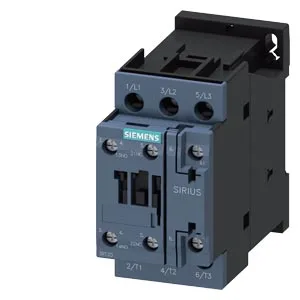
Duty-cycle and switching frequency
This contactor is rated for AC-3 switching (squirrel-cage motor starting) at 750 operating cycles per hour maximum, and AC-4 (plugging/inching) at 250 cycles per hour. The AC-1 resistive load rate is 1,000 cycles per hour. Those numbers tell you the thermal limit of the contactor under different load types — AC-4 generates more arc energy per cycle, so the allowable rate drops. For a conveyor line running continuous start/stop, the AC-3 rate is the one that governs.
The built-in auxiliary switch is rated for 10 A at 24 V, 2 A at 48/60 V, 1 A at 110 V, 0.9 A at 125 V, 0.3 A at 220 V, and 3 A at 400 V. At 230 V it carries a 5 hp motor load. These are the switching capacities for the control circuit — match them to your PLC output or relay coil draw. The 10 A at 24 V is generous for most DC control circuits.
Mechanical endurance and temperature range
The storage limit covers handling and shelf life, not running conditions.
Wiring and dimensions
Main contact terminals accept solid or stranded wire from 1 to 10 mm², or two conductors per terminal (2x 0.5–1.5 mm² or 2x 0.75–2.5 mm²). The contactor body is 85 mm high, 97 mm deep, and 45 mm wide. That 97 mm depth is the dimension from the DIN rail face to the farthest projection — check your enclosure depth before panel layout.