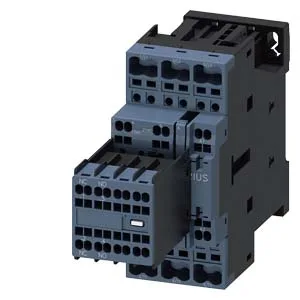
It mounts on a 35 mm DIN rail per DIN EN 60715, using either screw or snap-on fastening, and accepts a +/-180° rotation on a vertical surface plus +/-22.5° tilt forward/backward — useful when you're shoehorning it into a crowded gland plate. The coil is 24 VDC rated, and the main contacts use spring-type terminals (rated for solid or stranded 1... 10 mm², and 2x 0.5... 2.5 mm² for the coil). That spring cage saves you a turn on the screwdriver and holds firm under vibration — no re-torque on PM rounds.
This contactor is rated for AC-3 switching at 750 operations per hour maximum — that's the standard motor-start duty for a contactor this size, so it'll handle repetitive conveyor or pump starts without overheating the contacts. AC-4 (inching/plugging) is limited to 250 ops/h, which is typical; if your application does frequent reversing, keep that cycle count in mind. The auxiliary contact ratings are given for 24 VDC (6 A), 48 VDC (2 A), 110 VDC (1 A), and 220 VDC (0.3 A) — these are the DC break capacities for the built-in auxiliary block. If you're switching a DC control circuit, size your load to these numbers; the inductive DC arc is harder to extinguish than AC. That covers most indoor panel environments; if your panel sits next to a furnace or in a desert warehouse, the storage spec gives you headroom for spares on the shelf. Electrical life depends on your switching current and duty cycle, but the mechanical figure tells you the actuator and spring set are built for a long run.